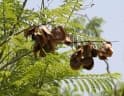
Jacaranda mimosifolia
Jacaranda mimosifolia
Safety & Hazards
None known
Botanical Description
Jacaranda mimosifolia is a deciduous tree with spreading branches making a light crown; it can grow 10 - 20 metres tall[ 303 Title World Agroforesty Centre Publication Author Website http://www.worldagroforestry.org/ Publisher Year 0 ISBN Description An excellent online database of a huge range of trees giving very good information on each plant - its uses, ecology, identity, propagation, pests etc. ]. The bole is almost always short and malformed, it can be up to 40 - 50cm in diameter[ 418 Title Ecocrop Publication Author Website http://ecocrop.fao.org/ecocrop/srv/en/home Publisher Year 0 ISBN Description Basic information on a wide range of useful plants, plus details of environmental needs where available. ]. The plant is gathered from the wild for local use as a medicine, fuel and source of timber. It has been introduced as an ornamental in most parts of the tropics, though in many tropical climates, especially at lower elevations, its flowering is light, irregular and disappointing[ 303 Title World Agroforesty Centre Publication Author Website http://www.worldagroforestry.org/ Publisher Year 0 ISBN Description An excellent online database of a huge range of trees giving very good information on each plant - its uses, ecology, identity, propagation, pests etc. ]. Although widely grown in cultivation, in the wild the species is reported to be endemic to the endangered piedmont forest of north-west Argentina and Bolivia. The plant is classified as 'Vulnerable' in the IUCN Red List of Threatened Species(2020)[ 338 Title IUCN Red List of Threatened Species Publication Author Website http://www.iucnredlist.org/ Publisher Year 0 ISBN Description A list of plants under threat and facing possible extinction, usually with brief details of the threats and information on habitat. ].