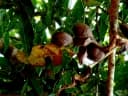
Archidendron jiringa
Archidendron jiringa
Safety & Hazards
Djenkolic acid, an amino acid derivative, has been found in the seed. Ingestion of the seed can cause the formation of sharp needle-like crystals of djenkolic acid in the kidney or urinary tract. In severe cases, crystals of djenkolic acid have been found in urine. Indeed, people who are suffering from djenkolism show similar symptoms to those suffering from kidney or urinary stones, a condition for which it has been frequently mistaken[ 306 Title Under-Utilized Tropical Fruits of Thailand. RAP Publication 2001/26 Publication Author Suranant Subhadrabandhu Website http://www.fao.org/3/a-ab777e.pdf Publisher F. A. O., The United Nations, Bangkok. Year 2001 ISBN Description A detailed report on 35 fruit species that could have potential for increased production in Thailand. The report can be downloadd as a PDF from the internet. ].
Botanical Description
Archidendron jiringa is an evergreen shrub or tree growing up to 20 metres tall. The straight bole can be unbranched for up to 10 metres, it is 60 - 90cm in diameter[ 451 Title Flora Malesiana Series 1 Publication Author Various Website http://www.archive.org Publisher Nationaal Herbarium Nederiand, Universiteit Leiden branch Year 0 ISBN Description A massive treatment of the plants of the Malaysian Archipelago. Much of it has been made available to download from the Internet ]. The plant, and especially the seed, is a popular vegetable in southeast Asia. It is harvested from the wild, wild trees are often saved when the forest is cleared, and it is also cultivated around villages. The seed is often sold in local markets[ 63 Title Nuts. Publication Author Howes. F. N. Publisher Faber Year 1948 ISBN - Description Rather old but still a masterpiece. Has sections on tropical and temperate plants with edible nuts plus a section on nut plants in Britain. Very readable. ]. The tree also supplies medicines, timber and a dye for local use.