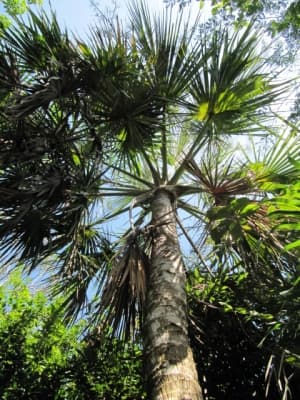
Sabal yapa
Sabal yapa
Safety & Hazards
None known
Botanical Description
Sabal yapa is a single-stemmed, evergreen palm growing up to 20 metres tall. The unbranched stem can be 15 - 26cm in diameter; it is topped by a crown of 15 - 20 fan-shaped leaves[ 768 Title Field Guide to the Palms of the Americas Publication Author Henderson A.; Galeano G.; Bernal R. Publisher Princeton University Press; Princeton, New Jersey. Year 1995 ISBN 0-691-08537-4 Description An excellent book, giving basic information on all the 550 species of palms native to the Americas that were known in 1995. Comprehensive information on the plants range and habitat, brief description, some uses and almost 250 photos. ]. Plants are often left growing when the forest is cleared for agriculture so that they can be used as a source of thatch material. They are also cultivated in plantations to provide their leaves. Sabal yapa has a wide distribution, The main threats to the taxon have been deforestation due to land-use change for human activities, and forest fires. Despite the change in land use that is occurring across its range, it is not considered to currently be significantly impacted by habitat loss. The plant is classified as 'Least Concern' in the IUCN Red List of Threatened Species(2013)[ 338 Title IUCN Red List of Threatened Species Publication Author Website http://www.iucnredlist.org/ Publisher Year 0 ISBN Description A list of plants under threat and facing possible extinction, usually with brief details of the threats and information on habitat. ].