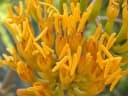
Agave angustifolia
Agave angustifolia
Safety & Hazards
Many Agave species have strong, sharp spines on the leaves and leaf tips. In theory at least, the flowers, nectar, immature flowering stem and the centre of the rosette of all Agave species is edible and, with proper preparation, can provide a sweet, tasty foodstuff. Some species, however, contain relatively high levels of saponins (which makes them taste bitter) and some other compounds which can cause bellyache, and so these would only be eaten in times of desperation. In addition, many people may find these foods to be strongly laxative the first few times they eat them[ 1846 Title The Agaves of Baja California Publication Occasional Papers of the California Academy of Sciences, No. 130, Author Gentry H.S. Publisher California Academy of Sciences; San Francisco Year 1978 ISBN 0068-5461 Description ].
Botanical Description
Agave angustifolia is an evergreen, stemless or short-stemmed (to 60cm), succulent plant forming a rosette of leaves that can be 100 - 200cm tall and 150 - 200cm in diameter. Around 40 - 70 leaves are produced on mature plants, each of which can be 60 - 100cm long and4 - 10 cm wide near the base. After several years of growth, a flowering stem that can be around 2.5 - 5 metres tall is produced, after which the rosette will die. However, the plant usually produces a number of young plants around its base that will develop as new plants[ 1844 Title Agave Agavaceae Publication Illustrated Handbook of Succulent Plants: Monocotyledons, pp 21-311 Author Thiede J. Website https://doi.org/10.1007/978-3-662-56486-8_111 Publisher Springer Nature Year 2020 ISBN Description ]. This is one of the main species in the genus for making the drink 'mezcal', a distilled alcoholic beverage that is very popular in Mexico and is also exported. The other uses of the plant are many and varied, including supplying food, fibre for ropes, construction material, fuel, beverages, traditional medicines and diverse utensils for local people[ 662 Title The confusion of Agave vivipara L. and A. angustifolia Haw., two distinct taxa. Publication Brittonia Vol 55 No.1, pp 82-87 Author Garcia-Mendoza A.; Chiang F. Publisher Brittonia; New York Year 2003 ISBN Description An article setting out the reasons why Agave angustifolia should be treated as a distinct species with a different range to Agave vivipara.. ]. The plant is often cultivated or managed in the wild for making mezcal, and is also grown as an ornamental[ 662 Title The confusion of Agave vivipara L. and A. angustifolia Haw., two distinct taxa. Publication Brittonia Vol 55 No.1, pp 82-87 Author Garcia-Mendoza A.; Chiang F. Publisher Brittonia; New York Year 2003 ISBN Description An article setting out the reasons why Agave angustifolia should be treated as a distinct species with a different range to Agave vivipara.. , 1845 Title Population Dynamics and Sustainable Management of Mescal Agaves in Central Mexico: Agave potatorum in the Tehuacán-C Publication Econ. Bot. 69(1): 26-41, 2015 Author Toees I. et al Website https://doi.org/10.1007/s12231-014-9295-2. Publisher Year 2015 ISBN Description ]. Agave angustifolia has a wide range, it is abundant and even though there are threats in parts of its range, it occurs in many protected areas and its overall population is stable. The plant is classified as 'Least Concern' in the IUCN Red List of Threatened Species(2019)[ 338 Title IUCN Red List of Threatened Species Publication Author Website http://www.iucnredlist.org/ Publisher Year 0 ISBN Description A list of plants under threat and facing possible extinction, usually with brief details of the threats and information on habitat. ].