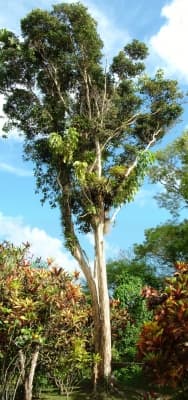
Pimenta racemosa
Pimenta racemosa
Safety & Hazards
The fruit, the essential oil in the leaves and the bay rum made from it, are all toxic and should not be ingested[ 423 Title Desert Tropicals Publication Author Website http://www.desert-tropicals.com/ Publisher Year 0 ISBN Description The main focus of the site is succulent plants, but it also contains information on a wide range of other species. Usually at least one good photograph, plus basic information about the plant and its cultivation. ]. Bay rum, as used in hair dressings and aftershaves, may cause irritation of the skin[ 310 Title Plant Resources of Southeast Asia Publication Author Website http://proseanet.org/ Publisher Year 0 ISBN Description Lots of information on the uses of the plants of SE Asia. ]. The essential oil is approved for food use by the Food and Drug Administration of the United States and is 'generally recognized as safe' (GRAS). However, contact dermatitis caused by the components eugenol and phellandrene of the essential oil has been reported[ 310 Title Plant Resources of Southeast Asia Publication Author Website http://proseanet.org/ Publisher Year 0 ISBN Description Lots of information on the uses of the plants of SE Asia. ].
Botanical Description
Pimenta racemosa is an evergreen tree with a dense, columnar, dark green crown; it usually grows up to 15 metres tall, but with some specimens up to 25 metres[ 310 Title Plant Resources of Southeast Asia Publication Author Website http://proseanet.org/ Publisher Year 0 ISBN Description Lots of information on the uses of the plants of SE Asia. ]. The bole, which is often slightly ridged and grooved, is up to 20cm in diameter[ 310 Title Plant Resources of Southeast Asia Publication Author Website http://proseanet.org/ Publisher Year 0 ISBN Description Lots of information on the uses of the plants of SE Asia. ]. The plant is harvested from the wild for its leaves and fruits, which are used as food flavourings, medicines and a source of essential oils. It is sometimes cultivated for its essential oil, and is also grown as an ornamental and shade-producing tree[ 447 Title Common Trees of Puerto Rico and the Virgin Islands Publication Author Little E.L.; Wadsworth F.H. Publisher USDA, Forest Service; Washington. Year 1964 ISBN Description Contains detailed information, and usually an illustration, on 250 tree species, including both native and exotic species. ],