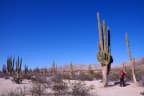
Pachycereus pringlei
Pachycereus pringlei
Safety & Hazards
None known
Botanical Description
Pachycereus pringlei is a large, spiny, succulent, tree-like cactus growing up to 12 metres tall. It has a short bole that can occasionally be up to 2 metres tall and up to 1 metre in diameter, with up to 30 erect, columnar branches forming a candelabra-like shape[ 423 Title Desert Tropicals Publication Author Website http://www.desert-tropicals.com/ Publisher Year 0 ISBN Description The main focus of the site is succulent plants, but it also contains information on a wide range of other species. Usually at least one good photograph, plus basic information about the plant and its cultivation. , 1986 Title Taxonomic Revision of Pachycereus (Cactaceae) Publication Systematic Botany, 34(1):68-83. 2009 Author Arias S. & Terrazas T. Website http:// http://www.bioone.org/doi/full/10.1600/036364409787602384 Publisher Year 2009 ISBN Description An excellent, comprehensive paper, it also lists plant uses. , 1987 Title The Cactus Family Publication Author Anderson E.F. Publisher Timber Press; Portland, Oregon Year 2001 ISBN 0-88192-498-9 Description An excellent work, giving botanical descriptions of virtually all the cacti, together with their range (but not their habitats) and sometimes also a photo. it also contains a long chapter detailing the many uses of cacti and another on cultivation.. ]. The plant is harvested from the wild for local use as a food and medicine, and also for its stems which are used for fuel and construction. The plant is grown as an ornamental in semi-arid regions, where it can be used to form a barrier hedge. Pachycereus pringlei is widespread and locally abundant. However, the subpopulations on the continent (which include the largest individuals) are in serious decline. On a global level the plant is currently classified as 'Least Concern' in the IUCN Red List of Threatened Species(2017)[ 338 Title IUCN Red List of Threatened Species Publication Author Website http://www.iucnredlist.org/ Publisher Year 0 ISBN Description A list of plants under threat and facing possible extinction, usually with brief details of the threats and information on habitat. ].