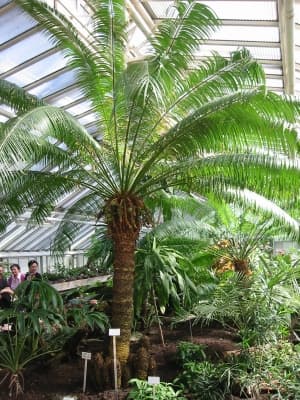
Cycas rumphii
Cycas rumphii
Safety & Hazards
The plants contain alkaloids of carcinogens and also an amino-acid that causes chronic nervous disorders[ 200 Title The New RHS Dictionary of Gardening. 1992. Publication Author Huxley. A. Publisher MacMillan Press Year 1992 ISBN 0-333-47494-5 Description Excellent and very comprehensive, though it contains a number of silly mistakes. Readable yet also very detailed. ]. Regular consumption of the plant leads to severe health problems and death. This toxic principle can be removed if the food is properly prepared but consumption of the plant still cannot be recommended because its use often means the death of the plant and it is becoming rare in the wild.
Botanical Description
Cycas rumphii is a slow-growing, evergreen, palm-like plant with an erect, sometimes branched, main stem that can eventually be up to 10 metres tall and 11 - 35cm in diameter; this is topped by a spreading crown of numerous large leaves each around 1.5 - 2.5 metres long[ 1935 Title The Cycads Publication Author Whitelock L.M. Publisher Timber Press; Portland, Oregon Year 2002 ISBN 0-88192-522-5 Description An excellent book dealing with the eleven different genera and almost 300 species of plants we know as Cycads. There are detailed descriptions and a host of other information for each species. ]. The plant has a range of traditional uses, especially as a food and a medicine. It is sometimes sold in local markets. The pith in the stem is often harvested from the wild and used as a food source in its native range, though recent research has shown that this is a potentially dangerous practice since the pith can cause chronic nervous disorders if it is not treated properly. Overall its use is not to be recommended, especially since it is becoming rare in the wild[ 200 Title The New RHS Dictionary of Gardening. 1992. Publication Author Huxley. A. Publisher MacMillan Press Year 1992 ISBN 0-333-47494-5 Description Excellent and very comprehensive, though it contains a number of silly mistakes. Readable yet also very detailed. ]. The plant is also grown as an ornamental. Occurs over a wide range in coastal areas, but this species has declined due to a habitat loss of 20% in the last 50 years. The plant is classified as 'Near Threatened' in the IUCN Red List of Threatened Species(2011)[ 338 Title IUCN Red List of Threatened Species Publication Author Website http://www.iucnredlist.org/ Publisher Year 0 ISBN Description A list of plants under threat and facing possible extinction, usually with brief details of the threats and information on habitat. ].