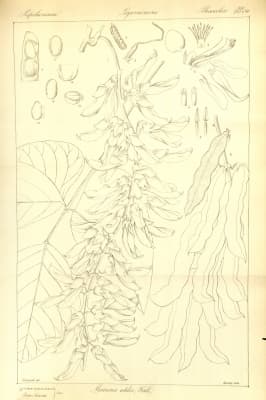
Mucuna pruriens utilis
Mucuna pruriens utilis
Safety & Hazards
The seed contains a range of anti-nutritive substances and can be toxic for human and non-ruminant animal consumption. The most important toxic compounds are the non-protein amino acids L-dopa (content in seeds <2% - >7%) and hallucinogenic tryptamines[ 415 Title Tropical Forages Publication Author Website http://www.tropicalforages.info/key/Forages/Media/Html/index.htm Publisher Year 0 ISBN Description Mainly focussed on forage plants, the site gives a lot of information on the plant, with a good botanical description, details of cultivation, plant uses and a good selection of photographs. ]. Furthermore, trypsin-inhibiting activities have been detected in the seed[ 415 Title Tropical Forages Publication Author Website http://www.tropicalforages.info/key/Forages/Media/Html/index.htm Publisher Year 0 ISBN Description Mainly focussed on forage plants, the site gives a lot of information on the plant, with a good botanical description, details of cultivation, plant uses and a good selection of photographs. ].
Botanical Description
Mucuna pruriens utilis is an annual, or sometimes a short-lived perennial, climbing plant producing twining stems that usually grow around 4 metres long but can occasionally be up to 18 metres[ 415 Title Tropical Forages Publication Author Website http://www.tropicalforages.info/key/Forages/Media/Html/index.htm Publisher Year 0 ISBN Description Mainly focussed on forage plants, the site gives a lot of information on the plant, with a good botanical description, details of cultivation, plant uses and a good selection of photographs. ]. The plant is harvested from the wild for local use as a food and a medicine. It is cultivated in parts of the tropics for its content of L-DOPA, which is used by the pharmaceutical industry, and is also grown as a green manure to improve the soil. The plant is widely cultivated in tropical areas as an animal feed, emergency human food and for medicinal purposes[ 238 Title Encyclopaedia of Herbs and their Uses. Publication Author Bown. D. Publisher Dorling Kindersley, London. Year 1995 ISBN 0-7513-020-31 Description A very well presented and informative book on herbs from around the globe. Plenty in it for both the casual reader and the serious student. Just one main quibble is the silly way of having two separate entries for each plant. ]. It differs mainly from the main species in that the seed pods of this plant do not have the irritant hairs found on the main species[ 238 Title Encyclopaedia of Herbs and their Uses. Publication Author Bown. D. Publisher Dorling Kindersley, London. Year 1995 ISBN 0-7513-020-31 Description A very well presented and informative book on herbs from around the globe. Plenty in it for both the casual reader and the serious student. Just one main quibble is the silly way of having two separate entries for each plant. ]. The plant is sometimes grown as an ornamental[ 310 Title Plant Resources of Southeast Asia Publication Author Website http://proseanet.org/ Publisher Year 0 ISBN Description Lots of information on the uses of the plants of SE Asia. ].