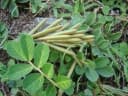
Indigofera hendecaphylla
Indigofera hendecaphylla
Safety & Hazards
Some strains of this species have leaves and seeds that are highly hepatotoxic[ 310 Title Plant Resources of Southeast Asia Publication Author Website http://proseanet.org/ Publisher Year 0 ISBN Description Lots of information on the uses of the plants of SE Asia. ]. The leaves of Indigofera hendecaphylla, possibly only of tetraploid forms originally from Sri Lanka, contain per 100 g dry matter 0.1 - 0.5 g indospicine (2,7-diamino-7-amino-heptanoic acid) while the seeds contain 0.1 - 2 g. Indospicine is a specific antagonist of arginine, interfering with its synthesis and incorporation into proteins and with the synthesis of DNA. Indospicine is highly toxic to chicken, rabbits, pigs, goats, sheep, cattle and horses. In small doses it causes loss of vitality and abortion in cattle and goats. Indospicine is especially dangerous to horses, which relish plants containing it and eat them preferentially[ 310 Title Plant Resources of Southeast Asia Publication Author Website http://proseanet.org/ Publisher Year 0 ISBN Description Lots of information on the uses of the plants of SE Asia. ]..
Botanical Description
Indigofera hendecaphylla is a sub-erect shrublet that grows 40 - 100cm tall and gradually becomes prostrate as it grows larger. The stems become creeping, up to 2 metres long and rooting at the nodes, with branches that are ascending. The main root can be 50 - 100cm long and 5 - 10mm wide[ 266 Title Flora of China Publication Author Website http://flora.huh.harvard.edu/china/ Publisher Missouri Botanical Garden Press; St. Louis. Year 1994 ISBN Description An excellent, comprehensive resource in 25 volumes. In addition to the botanical information the flora also gives basic information on habitat and some uses. An on-line version is also available. , 310 Title Plant Resources of Southeast Asia Publication Author Website http://proseanet.org/ Publisher Year 0 ISBN Description Lots of information on the uses of the plants of SE Asia. ]. The plan is used locally as a source of the blue dye indigo. Itt is a commonly grown and very popular green manure crop within its native range, especially in Asia, but also in Africa. It is also often cultivated outside its native range, in areas such as Australia and the Americas[ 310 Title Plant Resources of Southeast Asia Publication Author Website http://proseanet.org/ Publisher Year 0 ISBN Description Lots of information on the uses of the plants of SE Asia. ].