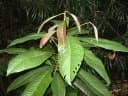
Eusideroxylon zwageri
Eusideroxylon zwageri
Safety & Hazards
The large fruits are poisonous[ 303 Title World Agroforesty Centre Publication Author Website http://www.worldagroforestry.org/ Publisher Year 0 ISBN Description An excellent online database of a huge range of trees giving very good information on each plant - its uses, ecology, identity, propagation, pests etc. , 418 Title Ecocrop Publication Author Website http://ecocrop.fao.org/ecocrop/srv/en/home Publisher Year 0 ISBN Description Basic information on a wide range of useful plants, plus details of environmental needs where available. ].
Botanical Description
Eusideroxylon zwageri is a slow-growing, evergreen tree that can reach a height of 40 - 50 metres. The straight bole can be clear of branches for up to half of the tree's height, and up to 150 - 220cm in diameter[ 303 Title World Agroforesty Centre Publication Author Website http://www.worldagroforestry.org/ Publisher Year 0 ISBN Description An excellent online database of a huge range of trees giving very good information on each plant - its uses, ecology, identity, propagation, pests etc. , 418 Title Ecocrop Publication Author Website http://ecocrop.fao.org/ecocrop/srv/en/home Publisher Year 0 ISBN Description Basic information on a wide range of useful plants, plus details of environmental needs where available. ]. The bole has many small, rounded buttresses that give the base an elephant-foot like appearance[ 418 Title Ecocrop Publication Author Website http://ecocrop.fao.org/ecocrop/srv/en/home Publisher Year 0 ISBN Description Basic information on a wide range of useful plants, plus details of environmental needs where available. ]. The tree is widely exploited in the wild for its valuable timber, which is one of the heaviest and most durable timbers of South-East Asia[ 310 Title Plant Resources of Southeast Asia Publication Author Website http://proseanet.org/ Publisher Year 0 ISBN Description Lots of information on the uses of the plants of SE Asia. ]. This species is one of the most renowned timbers of Borneo, the decline of which was first noted in 1955[ 338 Title IUCN Red List of Threatened Species Publication Author Website http://www.iucnredlist.org/ Publisher Year 0 ISBN Description A list of plants under threat and facing possible extinction, usually with brief details of the threats and information on habitat. ]. Population reduction, caused by overexploitation and shifting agriculture, has been noted in several areas[ 338 Title IUCN Red List of Threatened Species Publication Author Website http://www.iucnredlist.org/ Publisher Year 0 ISBN Description A list of plants under threat and facing possible extinction, usually with brief details of the threats and information on habitat. ]. Regeneration in logged-over forests is limited and so far the species is only planted on a small scale because the supply of seeds and seedlings is inadequate[ 338 Title IUCN Red List of Threatened Species Publication Author Website http://www.iucnredlist.org/ Publisher Year 0 ISBN Description A list of plants under threat and facing possible extinction, usually with brief details of the threats and information on habitat. ]. The tree has therefore been classified as 'Vulnerable' in the IUCN Red List of Threatened Species(2009)[ 338 Title IUCN Red List of Threatened Species Publication Author Website http://www.iucnredlist.org/ Publisher Year 0 ISBN Description A list of plants under threat and facing possible extinction, usually with brief details of the threats and information on habitat. ].