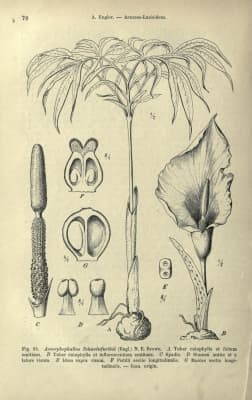
Amorphophallus abyssinicus
Amorphophallus abyssinicus
Safety & Hazards
Although no specific mention has been seen for this species, it belongs to a family where most of the members contain calcium oxalate crystals. This substance is toxic fresh and, if eaten, makes the mouth, tongue and throat feel as if hundreds of small needles are digging in to them. However, calcium oxalate is easily broken down either by thoroughly cooking the plant or by fully drying it and, in either of these states, it is safe to eat the plant. People with a tendency to rheumatism, arthritis, gout, kidney stones and hyperacidity should take especial caution if including this plant in their diet[ 238 Title Encyclopaedia of Herbs and their Uses. Publication Author Bown. D. Publisher Dorling Kindersley, London. Year 1995 ISBN 0-7513-020-31 Description A very well presented and informative book on herbs from around the globe. Plenty in it for both the casual reader and the serious student. Just one main quibble is the silly way of having two separate entries for each plant. ].
Botanical Description
Amorphophallus abyssinicus is a herbaceous, perennial plant with fleshy leaves growing up to 30cm tall from a subterranean tuber[ 332 Title The Useful Plants of West Tropical Africa. Publication Author Burkil. H. M. Publisher Royal Botanic Gardens; Kew. Year 1985 - 2004 ISBN Description Brief descriptions and details of the uses of over 4,000 plants. A superb, if terse, resource, it is also available electronically on the Web - see http://www.aluka.org/ ]. The tubers are sometimes gathered from the wild, mainly in times of shortage, as a local food source. The plant is sometimes cultivated as a food crop in fields and occasionally in gardens in Ethiopia[ 317 Title Mansfeld's Database of Agricultural and Horticultural Plants Publication Author Website http://mansfeld.ipk-gatersleben.de/pls/htmldb_pgrc/f?p=185:3:4292127278597336 Publisher Year 0 ISBN Description Terse details of a huge range of useful plants. ].