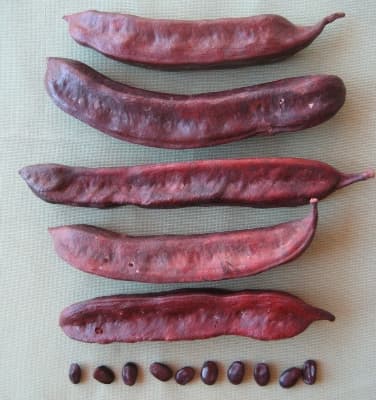
Amblygonocarpus andongensis
Amblygonocarpus andongensis
Safety & Hazards
The inner bark, roots and seeds have been recorded to be poisonous, but are used in various medicinal or food preparations[ 299 Title Protabase - Plant Resources of Tropical Africa. Publication Author Website http://www.prota.org Publisher Year 0 ISBN Description An excellent on-line database with detailed information on over 3,200 species of useful plants of Africa. ]. The pulverized pods are used as a fish poison[ 299 Title Protabase - Plant Resources of Tropical Africa. Publication Author Website http://www.prota.org Publisher Year 0 ISBN Description An excellent on-line database with detailed information on over 3,200 species of useful plants of Africa. ].
Botanical Description
Amblygonocarpus andongensis is a deciduous tree with a spreading crown; usually growing up to 20 metres tall, occasionally to 25 metres. The straight bole is unbuttressed, it can be branchless for up to 10 metres and up to 90cm in diameter[ 299 Title Protabase - Plant Resources of Tropical Africa. Publication Author Website http://www.prota.org Publisher Year 0 ISBN Description An excellent on-line database with detailed information on over 3,200 species of useful plants of Africa. , 328 Title African Flowering Plants Database Publication Author Website http://www.ville-ge.ch/musinfo/bd/cjb/africa/recherche.php Publisher Conservatoire et Jardin Botaniques. Year 0 ISBN Description Contains information on over 150,000 plant names (including synonyms) giving a description and habitat, plus a distribution map. ]. The tree has a range of uses, being harvested from the wild for food, medicines and as a source of wood, fuel and charcoal. A beautifully graceful plant that could be grown as an ornamental[ 332 Title The Useful Plants of West Tropical Africa. Publication Author Burkil. H. M. Publisher Royal Botanic Gardens; Kew. Year 1985 - 2004 ISBN Description Brief descriptions and details of the uses of over 4,000 plants. A superb, if terse, resource, it is also available electronically on the Web - see http://www.aluka.org/ ].