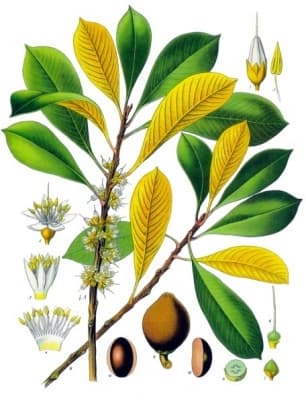
Palaquium gutta
Palaquium gutta
Safety & Hazards
None known
Botanical Description
Palaquium gutta is an evergreen tree usually growing up to 25 metres tall, but with some specimens up to 45 metres[ 310 Title Plant Resources of Southeast Asia Publication Author Website http://proseanet.org/ Publisher Year 0 ISBN Description Lots of information on the uses of the plants of SE Asia. , 334 Title Flora of Peninsula Malaysia Publication Author Website http://www.tfbc.frim.gov.my Publisher Year 0 ISBN Description In the process of being assembled (15/07/09), it is currently a series of check sheets giving species name, brief description, habitat and high quality photos of the plants. , 418 Title Ecocrop Publication Author Website http://ecocrop.fao.org/ecocrop/srv/en/home Publisher Year 0 ISBN Description Basic information on a wide range of useful plants, plus details of environmental needs where available. ]. It has a columnar bole up to 60 cm in diameter, usually with small buttresses[ 418 Title Ecocrop Publication Author Website http://ecocrop.fao.org/ecocrop/srv/en/home Publisher Year 0 ISBN Description Basic information on a wide range of useful plants, plus details of environmental needs where available. ]. This species is the main source of gutta-percha, a latex that was at one time widely employed as an insulator and for making a wide range of items. Its use has been largely replaced by synthetic materials, though it still has a range of applications and is cultivated in Indonesia[ 317 Title Mansfeld's Database of Agricultural and Horticultural Plants Publication Author Website http://mansfeld.ipk-gatersleben.de/pls/htmldb_pgrc/f?p=185:3:4292127278597336 Publisher Year 0 ISBN Description Terse details of a huge range of useful plants. ]. The tree also supplies an oil and a useful timber that is sometimes traded under the name 'Nyatoh'. Although Palaquium gutta has a wide range, there has been 17% tree cover loss within its range during a 16 year period. Based on this there is a projected continuing decline in the extent and quality of habitat and a suspected population decline.which would most likely be 25-30% if calculated for three generation lengths rather than 16 years. The plant is classified as 'Near Threatened' in the IUCN Red List of Threatened Species(2018)[ 338 Title IUCN Red List of Threatened Species Publication Author Website http://www.iucnredlist.org/ Publisher Year 0 ISBN Description A list of plants under threat and facing possible extinction, usually with brief details of the threats and information on habitat. ].