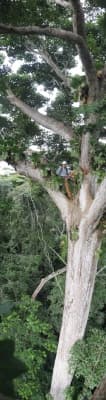
Triplochiton scleroxylon
Triplochiton scleroxylon
Safety & Hazards
The sawdust has been known to cause occupational allergic contact dermatitis, allergic rhinitis and asthma in workers in sawmills[ 299 Title Protabase - Plant Resources of Tropical Africa. Publication Author Website http://www.prota.org Publisher Year 0 ISBN Description An excellent on-line database with detailed information on over 3,200 species of useful plants of Africa. ].
Botanical Description
Triplochiton scleroxylon is a deciduous tree growing up to 50 metres tall. The bole is straight, often angular and strongly ridged; it can be branchless for up to 30 metres. It is usually up to 150cm in diameter, with exceptional specimens up to 210cm, with buttresses that can be up to 8 metres high[ 299 Title Protabase - Plant Resources of Tropical Africa. Publication Author Website http://www.prota.org Publisher Year 0 ISBN Description An excellent on-line database with detailed information on over 3,200 species of useful plants of Africa. ]. One of the major timber species of western Africa, it has been heavily exploited from the wild and is now commonly planted as a timber crop within its native range and also sometimes outside its range[ 299 Title Protabase - Plant Resources of Tropical Africa. Publication Author Website http://www.prota.org Publisher Year 0 ISBN Description An excellent on-line database with detailed information on over 3,200 species of useful plants of Africa. ]. The tree is also utilized locally for food and medicines. As a widely distributed pioneer species Triplochiton scleroxylon is not easily liable to genetic erosion, but in many regions within its distribution area it is under profound pressure because of excessive exploitation[ 299 Title Protabase - Plant Resources of Tropical Africa. Publication Author Website http://www.prota.org Publisher Year 0 ISBN Description An excellent on-line database with detailed information on over 3,200 species of useful plants of Africa. ]. In some areas the range of the plant is extending because of its successful colonisation of logged and abandoned farm land. It is classified as 'Least Concern' in the IUCN Red List of Threatened Species(2011)[ 338 Title IUCN Red List of Threatened Species Publication Author Website http://www.iucnredlist.org/ Publisher Year 0 ISBN Description A list of plants under threat and facing possible extinction, usually with brief details of the threats and information on habitat. ].