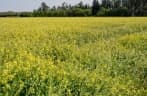
Brassica juncea
Brassica juncea
Safety & Hazards
An oil obtained from the seeds can have a high content of erucic acid. There have been some health concerns over the consumption of high levels of erucic acid n humans, though this is still controversial. At present (2012), several countries only allow cultivars with low erucic acid levels to be used for food.
Botanical Description
Brassica juncea is an erect, often unbranched annual to biennial plant growing up to 160cm tall when in flower[ 299 Title Protabase - Plant Resources of Tropical Africa. Publication Author Website http://www.prota.org Publisher Year 0 ISBN Description An excellent on-line database with detailed information on over 3,200 species of useful plants of Africa. ]. It is the parent of several distinct forms that are grown for food, oil etc - these are described in separate records. Brown mustard is widely cultivated for its edible seed which is a source of oil; is used to make the condiment 'brown mustard'; and is also sprouted as the mustard of mustard and cress[ 50 Title Flora Europaea Publication Author ? Publisher Cambridge University Press Year 1964 ISBN - Description An immense work in 6 volumes (including the index). The standard reference flora for Europe, it is very terse though and with very little extra information. Not for the casual reader. , 200 Title The New RHS Dictionary of Gardening. 1992. Publication Author Huxley. A. Publisher MacMillan Press Year 1992 ISBN 0-333-47494-5 Description Excellent and very comprehensive, though it contains a number of silly mistakes. Readable yet also very detailed. ]. It has only 70% of the pungency of black mustard (Brassica nigra) but can be harvested mechanically so is more viable commercially[ 238 Title Encyclopaedia of Herbs and their Uses. Publication Author Bown. D. Publisher Dorling Kindersley, London. Year 1995 ISBN 0-7513-020-31 Description A very well presented and informative book on herbs from around the globe. Plenty in it for both the casual reader and the serious student. Just one main quibble is the silly way of having two separate entries for each plant. ]. In addition to its edible uses, the plant also has a range of medicinal uses, is grown as a green manure and can be used to remove heavy metals from the soil. The plant has escaped from cultivation in many areas and can become an invasive weed[ 305 Title Pacific Island Ecosystems at Risk Publication Author Website http://www.hear.org/pier/scientificnames/index.html Publisher Year 0 ISBN Description A very good website detailing weed species that have been introduced into the Pacific Islands. ].