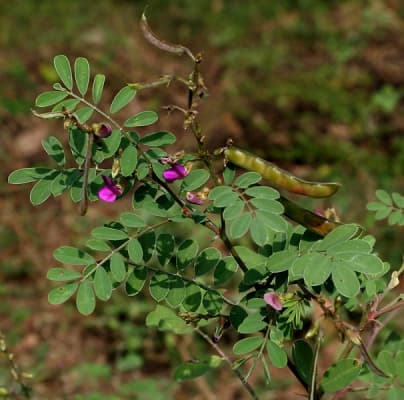
Tephrosia purpurea
Tephrosia purpurea
Safety & Hazards
The plant contains the rotenoid tephrosine, which stuns fish but not mammals[ 417 Title Hawaiian Ethnobotany Online Database Publication Author Website http://www2.bishopmuseum.org/ethnobotanydb/index.asp Publisher Year 0 ISBN Description Brief details on over 100 species of Hawaiian plants. ]. The pounded leaves are used to stupefy and catch fish[ 303 Title World Agroforesty Centre Publication Author Website http://www.worldagroforestry.org/ Publisher Year 0 ISBN Description An excellent online database of a huge range of trees giving very good information on each plant - its uses, ecology, identity, propagation, pests etc. , 417 Title Hawaiian Ethnobotany Online Database Publication Author Website http://www2.bishopmuseum.org/ethnobotanydb/index.asp Publisher Year 0 ISBN Description Brief details on over 100 species of Hawaiian plants. ]. The plant contains rotenonoids and has been used traditionally as a fish poison - rotenoids kill or stun the fish making them easy to catch, but the fish remain perfectly edible for mammals. Rotenonoids are classified by the World Health Organization as moderately hazardous. They are mildly toxic to humans and other mammals, but extremely toxic to many insects (hence their use as an insecticide) and aquatic life, including fish. This higher toxicity in fish and insects is because the lipophilic rotenonoid is easily taken up through the gills or trachea, but not as easily through the skin or the gastrointestinal tract. The lowest lethal dose for a child is 143 mg/kg, but human deaths from rotenone poisoning are rare because its irritating action causes vomiting. Deliberate ingestion of rotenone, however, can be fatal. The compound decomposes when exposed to sunlight and usually has an activity of six days in the environment.
Botanical Description
Purple tephrosia is an erect or spreading annual or short-lived perennial herb, sometimes bushy, usually growing from 40 - 80cm tall, rarely up to 1.5 metres[ 303 Title World Agroforesty Centre Publication Author Website http://www.worldagroforestry.org/ Publisher Year 0 ISBN Description An excellent online database of a huge range of trees giving very good information on each plant - its uses, ecology, identity, propagation, pests etc. ]. The plant has a range of traditional medicinal uses, being harvested from the wild and used locally. It is also cultivated as a green manure crop.