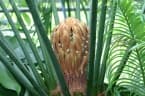
Cycas circinalis
Cycas circinalis
Safety & Hazards
The plants contain alkaloids of carcinogens and also an amino acid that causes chronic nervous disorders[ 200 Title The New RHS Dictionary of Gardening. 1992. Publication Author Huxley. A. Publisher MacMillan Press Year 1992 ISBN 0-333-47494-5 Description Excellent and very comprehensive, though it contains a number of silly mistakes. Readable yet also very detailed. ]. Regular consumption of the plant leads to severe health problems and death. This toxic principle can be removed if the food is properly prepared but consumption of the plant still cannot be recommended because its use often means the death of the plant and it is becoming rare in the wild. When fresh the seeds are so poisonous that the water in which they are steeped is fatal to chickens if drunk by them[ 459 Title The Useful Plants of the Island of Guam Publication Contributions from the United States National Herbarium Vol 9 Author Safford W.E. Website http://www.biodiversitylibrary.org/ Publisher Smithsonian Institute; Washington. Year 1905 ISBN Description A very comprehensive, if rather dated, guide to the plants of Guam. It can be downloaded from the Internet. ]. However, when they are split and soaked in several changes of water, the poison is released from the seeds and they are eaten
Botanical Description
Cycas circinalis is a medium sized suckering cycad, growing 3 - 5 metres tall, exceptionally to 10 metres. A rather palm-like appearance, it produces one or more, usually unbranched stems around 27 - 43cm in diameter, topped with a crown of large, bright green, glossy leaves 150 - 250cm long[ 314 Title Palm and Cycad Societies of Australia. Publication Author Website http://www.pacsoa.org.au/ Publisher Year 0 ISBN Description Contains at least a little information on the majority of palm and cycad species, plus a wealth of photographs. A first class website. , 990 Title The Cycad Pages Publication Author Website http://plantnet.rbgsyd.nsw.gov.au/PlantNet/cycad/wlist.html Publisher Royal Botanic Gardens, Sydney. Year 2012 ISBN Description A website dedicated to the various species of Cycad, with a comprehensive description of all the known species (as of 2012). At present (2015), the site is still running but is no longer being updated , 1933 Title A Taxonomic Revision of the Genera Cycas and Epicycas gen. nov. (Cycadaceae) Publication Blumea 43 (1998) 351-400 Author de Laubenfels D.J. & Adema F. Publisher Year 1998 ISBN Description ]. Usually evergreen, the plant can lose its leaves in extremely dry seasons[ 990 Title The Cycad Pages Publication Author Website http://plantnet.rbgsyd.nsw.gov.au/PlantNet/cycad/wlist.html Publisher Royal Botanic Gardens, Sydney. Year 2012 ISBN Description A website dedicated to the various species of Cycad, with a comprehensive description of all the known species (as of 2012). At present (2015), the site is still running but is no longer being updated ]. The plant is harvested from the wild for local use as a food, medicine and source of materials, and is sometimes sold in local markets[ 1934 Title Economic Botany of the Cycads Publication Econ Bot 12, 3-41 (1958) Author Thieret J.W. Website https://doi.org/10.1007/BF02863122 Publisher Year 1958 ISBN Description ]. The pith in the stem is often harvested from the wild and occasionally from cultivated plants. It is used as a food source in its native range, though recent research has shown that this is a potentially dangerous practice since the pith can cause chronic nervous disorders if it is not treated properly. Overall its use is not to be recommended, especially since it is becoming rare in the wild[ 200 Title The New RHS Dictionary of Gardening. 1992. Publication Author Huxley. A. Publisher MacMillan Press Year 1992 ISBN 0-333-47494-5 Description Excellent and very comprehensive, though it contains a number of silly mistakes. Readable yet also very detailed. ]. The plant is also grown as an ornamental. Populations of this species are declining. Land clearing is thought to have destroyed more than 50% of its original habitat, whilst harvesting the leaves for the urban floricultural market may also have had an impact. The leaves and pith of stem have medicinal properties, large and old specimens are ruthlessly hacked down for the extraction of the pith. The seeds are harvested and used for food as a regular part of the diet. The plant is classified as 'Endangered' in the IUCN Red List of Threatened Species(2010)[ 338 Title IUCN Red List of Threatened Species Publication Author Website http://www.iucnredlist.org/ Publisher Year 0 ISBN Description A list of plants under threat and facing possible extinction, usually with brief details of the threats and information on habitat. ].