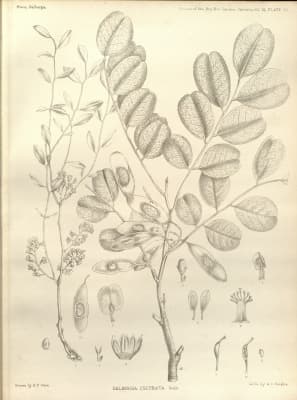
Dalbergia cultrata
Dalbergia cultrata
Safety & Hazards
None known
Botanical Description
Dalbergia cultrata is a deciduous tree with an open, narrow crown; it can grow from 10 - 30 metres tall. The bole is straight[ 598 Title Trees of Laos and Vietnam - A Field Guide to 100 species. Publication Author Hoang Van Sam; Khamseng Nanthavong; Kessler P.J.A. Publisher Blumea Year 2004 ISBN Description A detailed guide, with excellent line-drawings, to 100 of the more important trees of Laos and Vietnam. A very good work, giving lots of information about each plant. Originally published in the journal Blumea, it is available as a PDF on the Interne ]. The tree is harvested from the wild for its timber, resin and oil. The timber is said to be of very good quality and the tree is one of 33 species named as being a suitable Hongmu (red wood) timber, used for producing high quality Chinese furniture following traditions from the Ming and Quing dynasty, which makes it a particularly valuable wood[ 1791 Title The Hongmu Challenge; A briefing for the 66th meeting of the CITES Standing Committee, January 2016 Publication Author Website http://www.eia-global.org Publisher Environmental Investigation Agency; London Year 2016 ISBN Description Lists the 33 species used in making Hungmu furniture and the degree of over-exploitation plus recommendations for protecting them. ]. The tree is grown in reforestation projects in Thailand[ 998 Title Forest Restoration Planting in Northern Thailand Publication Proceedings of the Southeast Asian Moving Workshop on Conservation, Management and Utilization of Forest Genetic Resources No. 31/2002 Author Pakkad G.; Elliott S.; Anusarnsunthorn V. Et al Website http://www.fao.org/ Publisher Food and Agriculture Organization of the United Nations; Bangkok Year 2002 ISBN Description A report on reforestation in northern Thailand by using specific pioneer species. It can be downloaded from the Internet. ]. The distribution range of Dalbergia cultrata extends over a wide area at present, but the species has been described as decreasing due to the severe reduction of forest areas in the countries where it occurs and to the overexploitation of the timber. Deforestation has contributed to the increasing fragmentation of the forested areas, which might also lead to reduced genetic diversity and genetic flow between the various subpopulations. The plant is classified as 'Near Threatened' in the IUCN Red List of Threatened Species(2013)[ 338 Title IUCN Red List of Threatened Species Publication Author Website http://www.iucnredlist.org/ Publisher Year 0 ISBN Description A list of plants under threat and facing possible extinction, usually with brief details of the threats and information on habitat. ].