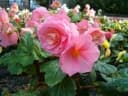
Begonia ×tuberhybrida
Begonia ×tuberhybrida
Safety & Hazards
The plant contains relatively high levels of oxalic acid[ 301 Title Cornucopia II Publication Author Facciola. S. Publisher Kampong Publications, California. Year 1998 ISBN 0-9628087-2-5 Description The second edition of an excellent guide to the edible uses of plants, though it does not give any details of cultivation etc. ]. Perfectly alright (and tasty) in small quantities, it is best not to eat large amounts of this plant since oxalic acid can bind up the body's supply of calcium leading to nutritional deficiency. It is oxalic acid that gives foods such as rhubarb their acid flavour. Cooking greatly reduces the oxalic acid content. People with a tendency to rheumatism, arthritis, gout, kidney stones or hyperacidity should take especial caution if including this plant in their diet since it can aggravate their condition[ 238 Title Encyclopaedia of Herbs and their Uses. Publication Author Bown. D. Publisher Dorling Kindersley, London. Year 1995 ISBN 0-7513-020-31 Description A very well presented and informative book on herbs from around the globe. Plenty in it for both the casual reader and the serious student. Just one main quibble is the silly way of having two separate entries for each plant. ].
Botanical Description
Tuberous begonias are a range of hybrids that vary greatly in size. The plants are herbaceous perennials growing up to 60cm tall from a tuberous rootstock. The plant is widely grown as an ornamental throughout the world, being restricted to pot plants in the temperate zone but grown in gardens in warmer areas. The flowers can be harvested for use in salads etc.