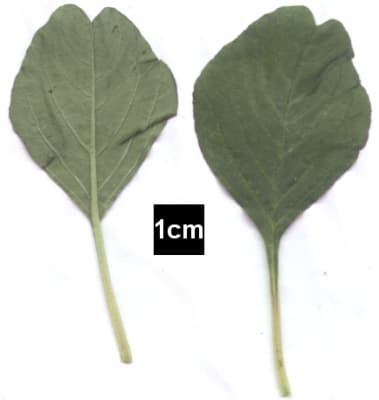
Amaranthus graecizans
Amaranthus graecizans
Safety & Hazards
No members of this genus are known to be poisonous, but when grown on nitrogen-rich soils they are known to concentrate nitrates in the leaves. This is especially noticeable on land where chemical fertilizers are used. Nitrates are implicated in stomach cancers, blue babies and some other health problems. It is inadvisable, therefore, to eat this plant if it is grown inorganically.
Botanical Description
Amaranthus graecizans is an annual, prostrate or decumbent plant usually growing around 50cm tall, but sometimes reaching 150cm. It is often strongly branched from the base[ 299 Title Protabase - Plant Resources of Tropical Africa. Publication Author Website http://www.prota.org Publisher Year 0 ISBN Description An excellent on-line database with detailed information on over 3,200 species of useful plants of Africa. , 328 Title African Flowering Plants Database Publication Author Website http://www.ville-ge.ch/musinfo/bd/cjb/africa/recherche.php Publisher Conservatoire et Jardin Botaniques. Year 0 ISBN Description Contains information on over 150,000 plant names (including synonyms) giving a description and habitat, plus a distribution map. ]. The edible leaves and seeds are sometimes gathered from the wild and used locally. The plant is often allowed to remain as a weed in eastern Africa, where it is also occasionally cultivated as a leaf crop for Indian people living in East Africa[ 299 Title Protabase - Plant Resources of Tropical Africa. Publication Author Website http://www.prota.org Publisher Year 0 ISBN Description An excellent on-line database with detailed information on over 3,200 species of useful plants of Africa. ].