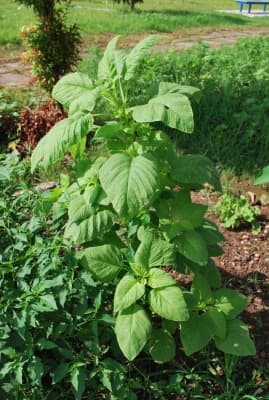
Amaranthus mangostanus
Amaranthus mangostanus
Safety & Hazards
No members of this genus are known to be poisonous, but when grown on nitrogen-rich soils they are known to concentrate nitrates in the leaves. This is especially noticeable on land where chemical fertilizers are used. Nitrates are implicated in stomach cancers, blue babies and some other health problems. It is inadvisable, therefore, to eat this plant if it is grown inorganically.
Botanical Description
Amaranthus mangostanus is a vigorous annual plant; the erect stem is often branched, it can grow 80 - 150cm tall[ 266 Title Flora of China Publication Author Website http://flora.huh.harvard.edu/china/ Publisher Missouri Botanical Garden Press; St. Louis. Year 1994 ISBN Description An excellent, comprehensive resource in 25 volumes. In addition to the botanical information the flora also gives basic information on habitat and some uses. An on-line version is also available. ]. The plant is harvested from the wild for use as a food. It is often cultivated for its edible leaves and seeds, the leaves are sold in local food markets in Korea[ 1665 Title Wild Food Plants in South Korea; Market Presence, New Crops, and Exports to the United States Publication Economic Botany, Vol. 50, No. 1 (Jan. - Mar., 1996), pp. 57-70 Author Pemberton R.W. & Nam Sook Lee Website http://www.jstor.org/stable/4255805 Publisher Year 1996 ISBN Description ].