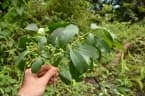
Rauvolfia vomitoria
Rauvolfia vomitoria
Safety & Hazards
The roots, either alone or combined with the seeds of Strophanthus gratus, are pounded to a paste and used as an arrow poison[1]. In DR Congo the roots are a common additive to Periploca nigrescens for use as a hunting poison[1]. In Equatorial Guinea the root scrapings are mixed with cassava meal and put in bait for use as a rat poison[1].
Cultivation Details
A plant of moist areas in the tropics, where it can be found at elevations up to 1,600 metres. It is found in areas where the mean annual temperature is around 26°c and the mean annual rainfall around 1,375mm[2]. The roots may be harvested annually in a non-destructive way by cutting them 10cm from the taproot. All plant parts are harvested whenever the need arises[1]. Dry season samples of the roots have been found to contain a higher content of alkaloids than wet season samples[1]. The plant can flower and produce fruit all year round[1]. Trees can be coppiced or pollarded[1]. In the 1970s the stem bark and root bark of Rauvolfia vomitoria were collected from West and Central Africa, and nearly 200 tonnes of reserpine were sold in total, mainly in tablet form for use in human medicines. Reserpine was also widely added as a sedative to animal feed. Nowadays, reserpine is still widely sold through the internet, mainly in India and the United States[1]. Rauvolfia vomitoria has flowers of two different shapes: slender, small flowers and robust flowers. The slender flowers occur, as far as verified, on diploid plants, while the robust flowers occur on hexaploid plants. Both flower types occur throughout the area of distribution, although the large-flowered type is not known from East Africa. The root bark of diploid plants contains less reserpine than that of hexaploids[1]. The tree is reported to form root nodules that fix atmospheric nitrogen in combination with vesicular arbiscular mycorrhiza[2].
Propagation
Seed - best sown as soon as it is ripe because it has a viability of no more than 6 months[1]. Wild seedlings can be successfully transplanted and cultivated[1]. Tests with vegetative propagation of root and shoot cuttings in vitro have been moderately successful[1]. Cite as: Tropical Plants Database, Ken Fern. tropical.theferns.info. 2026-02-20. <tropical.theferns.info/viewtropical.php?id=Rauvolfia+vomitoria>
Pollinators
Bees, Flies
References
- [1]Protabase - Plant Resources of Tropical Africa. — http://www.prota.org ↩︎An excellent on-line database with detailed information on over 3,200 species of useful plants of Africa.
- [2]World Agroforesty Centre — http://www.worldagroforestry.org/ ↩︎An excellent online database of a huge range of trees giving very good information on each plant - its uses, ecology, identity, propagation, pests etc.
- [3]Flora of Tropical East Africa — Beentje H.J. · Royal Botanic Gardens; Kew. · 2002 · http://plants.jstor.org/search?st=396814 ↩︎Available on-line, a modern flora of East Africa.