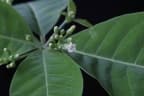
Apocynaceae FAMILY
Rauvolfia tetraphylla
Rauvolfia tetraphylla
Edibility
0/5
Medicinal
3/5
Safety & Hazards
The fruit is generally considered to be poisonous[1].
Cultivation Details
HabitShrub
Growth—
Succeeds in full sun to partial shade, preferring a rich, well-drained soil. The plant is known to flourish equally well in much-exposed, sunny, sandy soils near the seashore and also in wet and marshy, shady grasslands at elevations of about 2,000 metres[2]. The plant can commence flowering in its first year from seed[2]. It can flower and fruit almost all year round[2].
Propagation
Seed - Cite as: Tropical Plants Database, Ken Fern. tropical.theferns.info. 2026-02-20. <tropical.theferns.info/viewtropical.php?id=Rauvolfia+tetraphylla>
Pollinators
Data unavailable
References
- [1]Flora of Guatemala — Standley P.C. & J. A. Steyermark · 1946 - 1976 · http://www.archive.org/ ↩︎A superb reference, though somewhat dated. Gives lots of plant uses as well as information on plant habit and habitat. The entire flora (13 volumes) can now be downloaded from http://www.archive.org/
- [2]Annals of the Missouri Botanical Garden Vol. 43 — Missouri Botanical Garden · 1956 · http://www.biodiversitylibrary.org ↩︎A botanical publication, it includes a treatment of the genus Rauvolfia. It can be downloaded from the Internet.
- [3]Flora of China — Missouri Botanical Garden Press; St. Louis. · 1994 · http://flora.huh.harvard.edu/china/ ↩︎An excellent, comprehensive resource in 25 volumes. In addition to the botanical information the flora also gives basic information on habitat and some uses. An on-line version is also available.
- [4]Mansfeld's Database of Agricultural and Horticultural Plants — http://mansfeld.ipk-gatersleben.de/pls/htmldb_pgrc/f?p=185:3:4292127278597336 ↩︎Terse details of a huge range of useful plants.
- [5]Dictionary of Economic Plants. — Uphof. J. C. Th. · Weinheim · 1959 · ISBN - ↩︎An excellent and very comprehensive guide but it only gives very short descriptions of the uses without any details of how to utilize the plants. Not for the casual reader.
- [6]Flora of Yucatan — Standley P.C. · Field Museum of Natural History; Chicago · 1930 · http://www.biodiversitylibrary.org ↩︎The first flora that was attempted for this area in 1930, so it is obviously lacking information and the Botanical names can be out of date. Still, an excellent work and it records many plant uses. It can be downloaded from the Internet.
- [7]Flowers of India — http://www.flowersofindia.net/ ↩︎A wed site of native Indian plants, plus cultivated and naturalized species. It has good quality photos and terse details on more than 3,000 species and cultivars.