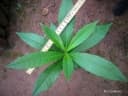
Rauvolfia caffra
Rauvolfia caffra
Safety & Hazards
Although we have seen no specific information for this species, most if not all members of this genus contain poisonous alkaloids[PFAF].
Cultivation Details
The plant is found from the tropics to the subtropics, where it grows at elevations up to 2,500 metres. It grows in areas where the mean temperatures range from 16 - 24°c and the mean annual rainfall from 500 - 1,270mm[1]. It is intolerant of frost[2]. The plant needs shade when young; old trees, however, do not tolerate shade[2]. It appears to prefer fairly fertile soils that are well drained. It grows in the wild on loamy sands to sandy clay-loam soils. When growing away from rivers and streams it is always associated with the availability of ground water[2, 1]. Young trees transplant well[3]. When established, the plants have a fast growth rate that can be up to 1.5metres a year[2]. Roots may be harvested annually in a non-destructive way by cutting them 10cm from the taproot. All plant partsare harvested whenever the need arises[2]. The tree should not be grown near houses, pavements etc because of its large size and invasive root system[2] The plant can be coppiced or pollarded[2, 1].
Propagation
Seed - Rauvolfia caffra regenerates by seed, cuttings and suckers. The number of seeds/kg is 4,500-5,000. Before sowing, the fruit pulp is removed by washing the seeds in water. The seeds are sown in seedling trays filled with a mixture of river sand and compost (1:1), and covered with a thin layer of sand or left on the surface. Germination is fast and reaches up to 80% after two weeks. The seedlings are transplanted into nursery beds when they reach the 3-leaf stage and are 25-30 cm tall. They need regular watering for the first3 months after transplanting into the field. Seeds retain viability only for a short period of about 1 month at room temperature, although other sources mention that seed germinates even after staying on the forest floor for a long time[2]. Cite as: Tropical Plants Database, Ken Fern. tropical.theferns.info. 2026-02-20. <tropical.theferns.info/viewtropical.php?id=Rauvolfia+caffra>
Pollinators
Data unavailable
References
- [1]Indigenous multipurpose trees of Tanzania. — Hines. D.A. & Eckman. K. · 1993 · ISBN 0-9697075-0-9 ↩︎A simple handbook with information on over 50 species of trees found in Tanzania giving details of environmental requirements, cultivation needs, uses etc. It can be downloaded from the Internet.
- [2]Protabase - Plant Resources of Tropical Africa. — http://www.prota.org ↩︎An excellent on-line database with detailed information on over 3,200 species of useful plants of Africa.
- [3]World Agroforesty Centre — http://www.worldagroforestry.org/ ↩︎An excellent online database of a huge range of trees giving very good information on each plant - its uses, ecology, identity, propagation, pests etc.
- [4]Flora Zambesiaca — http://apps.kew.org/efloras/fz/intro.html ↩︎An excellent online flora of plants from the Zambezi River basin. It lists a number of the plant uses as well as the habitats and botanical descriptions of the plants.
- [PFAF]Plants for a Future — pfaf.org ↩︎