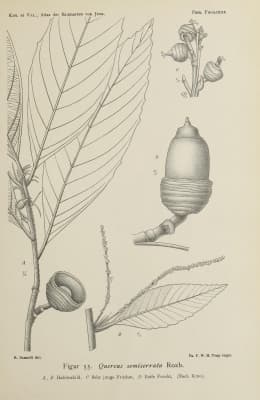
Quercus semiserrata
Quercus semiserrata
Safety & Hazards
All parts of the plant contain tannins. Whilst tannins are found in many foods, and have a range of medicinal uses. They are usually only present in low concentrations. In some foods made from oaks (particularly the seeds), the tannin content can be quite high unless the food is treated to reduce tannin content. Tannins are only of low toxicity and, because of their bitter taste and astringency, are unlikely to be eaten in large quantities. However, if they are taken in excess, they can cause stomach pains; constipation followed by bloody diarrhoea: excessive thirst; and excessive urination[1].
Cultivation Details
A fast-growing species[2].
Propagation
Seed - it quickly loses viability if it is allowed to dry out. It can be stored moist and cool, but is best sown as soon as it is ripe in an outdoor seed bed, though it must be protected from mice, squirrels etc. Small quantities of seed can be sown in deep pots in a cold frame. Plants produce a deep taproot and need to be planted out into their permanent positions as soon as possible, in fact seed sown in situ will produce the best trees[3]. Trees should not be left in a nursery bed for more than 2 growing seasons without being moved or they will transplant very badly. Cite as: Tropical Plants Database, Ken Fern. tropical.theferns.info. 2026-02-20. <tropical.theferns.info/viewtropical.php?id=Quercus+semiserrata>
Pollinators
Wind
References
- [1]Poisonous Plants of North Carolina — http://www.ces.ncsu.edu/depts/hort/consumer/poison/poison.htm ↩︎An excellent concise but comprehensive guide to toxic plants that grow in N. Carolina. It lists even those plants that are of very low toxicity, including several well-known food plants such as carrots and potatoes.
- [2]Forest Restoration Planting in Northern Thailand — Pakkad G.; Elliott S.; Anusarnsunthorn V. Et al · Food and Agriculture Organization of the United Nations; Bangkok · 2002 · http://www.fao.org/ ↩︎A report on reforestation in northern Thailand by using specific pioneer species. It can be downloaded from the Internet.
- [3]Trees and Shrubs Hardy in Great Britain. Vol 1 - 4 and Supplement. — Bean. W. · Murray · 1981 · ISBN - ↩︎A classic with a wealth of information on the plants, but poor on pictures.
- [4]A Field Guide to Forest Trees of Northern Thailand — Gardener S.; Sidisunthorn P.; Anusarnsunthorn V. · Kobfai Publishing Project; Bangkok. · 2000 · ISBN 974-7799-01-4 ↩︎An excellent, concise guide to 430 species, plus notes on another 450 species. Excellent photographs and a separate section on distribution and plant uses.
- [5]Flora of China — Missouri Botanical Garden Press; St. Louis. · 1994 · http://flora.huh.harvard.edu/china/ ↩︎An excellent, comprehensive resource in 25 volumes. In addition to the botanical information the flora also gives basic information on habitat and some uses. An on-line version is also available.
- [6]Flora of Guatemala — Standley P.C. & J. A. Steyermark · 1946 - 1976 · http://www.archive.org/ ↩︎A superb reference, though somewhat dated. Gives lots of plant uses as well as information on plant habit and habitat. The entire flora (13 volumes) can now be downloaded from http://www.archive.org/
- [7]A Modern Herbal. — Grieve. · Penguin · 1984 · ISBN 0-14-046-440-9 ↩︎Not so modern (1930's?) but lots of information, mainly temperate plants.
- [8]Antibacterial and Antifungal Activities of Some Quercus Species Growing in Turkey — Didem Söhretoğlu; Melike Ekizoğlu; Ekrem Kiliç; M. Koray Sak · 2007 ↩︎
- [9]Companion Planting for Successful Gardening. — Riotte. L. · Garden Way, Vermont, USA. · 1978 · ISBN 0-88266-064-0 ↩︎Fairly good.
- [10]A Manual of Indian Timbers. — Gamble. J. S. · Bishen Singh Mahendra Pal Singh · 1972 · ISBN - ↩︎First written in the 19th century, but still a classic, giving a lot of information on the uses and habitats of Indian trees. Not for the casual reader.
- [PFAF]Plants for a Future — pfaf.org ↩︎