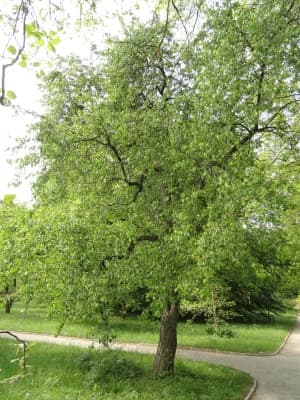
Pyrus pashia
Pyrus pashia
Safety & Hazards
Although no specific information has been seen for this plant, the seed of many species in the family Rosaceae are likely to contain cyanogenic glycosides. When injested, these compounds break down in the digestive tract to release cyanide. Used in small quantities in both traditional and conventional medicine, this exceedingly poisonous compound has been shown to stimulate respiration, improve digestion, and promote a sense of well-being[1]. It is also claimed by some to be of benefit in the treatment of cancer - though this claim has been largely refuted. In larger concentrations, however, cyanide can cause gasping, weakness, excitement, pupil dilation, spasms, convulsions, coma and respiratory failure leading to death[2]. The levels of toxin can be detected by the level of bitterness:- sweet almonds, for example, contain only very low levels of it and are safe to eat in quantity, whilst bitter almonds (which are used as a flavouring in foods such as marzipan) contain much higher levels and should only be eaten in very small quantities. Great caution should be employed if the taste is moderately to very bitter[PFAF].
Cultivation Details
Pyrus pashia is a very cold-hardy plant, tolerating temperatures down to at least -15°c when dormant[3]. The tree also has a low chilling requirement and is the species of Pyrus best suited for growing in a hot, humid climate[4]. Prefers a good well-drained loam in full sun[3]. Grows well in heavy clay soils. Tolerates light shade but does not fruit so well in such a position. Tolerates atmospheric pollution, excessive moisture and a range of soil types if they are moderately fertile[3]. Established plants are drought tolerant[3]. This tree is cultivated in Yunnan[5]. The implication is that it could be for the fruit, but it could also mean as an ornamental or as a rotstock[PFAF]. The tree is sometimes cultivated for its fruit in the Himalayas[6]. A mature tree yields about 45kg of fruit per year[7]. The var Pyrus pashia var grandiflora Cardot has larger flowers than the type (around 30mm in diameter) and can be grown as an ornamental[5].
Propagation
Seed - best sown in a cold frame as soon as it is ripe in the autumn, it will then usually germinate in mid to late winter. Stored seed requires 8 - 10 weeks cold stratification at 1°c and should be sown as early in the year as possible[3]. Temperatures over 15 - 20°c induce a secondary dormancy in the seed[3]. Prick out the seedlings into individual pots when they are large enough to handle and grow them on in light shade in a cold frame or greenhouse for their first year. Plant them out in late spring or early summer of the following year. Cite as: Temperate Plants Database, Ken Fern. temperate.theferns.info. 2026-02-21. <temperate.theferns.info/plant/Pyrus+pashia>
Pollinators
Bees, Insects
References
- [1]Encyclopaedia of Herbs and their Uses. — Bown. D. · Dorling Kindersley, London. · 1995 · ISBN 0-7513-020-31 ↩︎A very well presented and informative book on herbs from around the globe. Plenty in it for both the casual reader and the serious student. Just one main quibble is the silly way of having two separate entries for each plant.
- [2]Poisonous Plants of North Carolina — http://www.ces.ncsu.edu/depts/hort/consumer/poison/poison.htm ↩︎An excellent concise but comprehensive guide to toxic plants that grow in N. Carolina. It lists even those plants that are of very low toxicity, including several well-known food plants such as carrots and potatoes.
- [3]The New RHS Dictionary of Gardening. 1992. — Huxley. A. · MacMillan Press · 1992 · ISBN 0-333-47494-5 ↩︎Excellent and very comprehensive, though it contains a number of silly mistakes. Readable yet also very detailed.
- [4]Plant Resources of Southeast Asia — http://proseanet.org/ ↩︎Lots of information on the uses of the plants of SE Asia.
- [5]Flora of China — Missouri Botanical Garden Press; St. Louis. · 1994 · http://flora.huh.harvard.edu/china/ ↩︎An excellent, comprehensive resource in 25 volumes. In addition to the botanical information the flora also gives basic information on habitat and some uses. An on-line version is also available.
- [6]Flowers of India — http://www.flowersofindia.net/ ↩︎A wed site of native Indian plants, plus cultivated and naturalized species. It has good quality photos and terse details on more than 3,000 species and cultivars.
- [7]Wild Fruits of the Sub-Himalayan Region. — Parmar. C. and Kaushal. M.K. · Kalyani Publishers. New Delhi. · 1982 · ISBN - ↩︎Contains lots of information on about 25 species of fruit-bearing plants of the Himalayas, not all of them suitable for cool temperate zones.
- [8]Trees and Shrubs Hardy in Great Britain. Vol 1 - 4 and Supplement. — Bean. W. · Murray · 1981 · ISBN - ↩︎A classic with a wealth of information on the plants, but poor on pictures.
- [9]Flowers of the Himalayas. — Polunin. O. and Stainton. A. · Oxford Universtiy Press · 1984 · ISBN - ↩︎A very readable and good pocket guide (if you have a very large pocket!) to many of the wild plants in the Himalayas. Gives many examples of plant uses.
- [10]Sturtevant's Edible Plants of the World. — Hedrick. U. P. · Dover Publications · 1972 · ISBN 0-486-20459-6 ↩︎Lots of entries, quite a lot of information in most entries and references.
- [11]Tanaka's Cyclopedia of Edible Plants of the World. — Tanaka. T. & Nakao S. · Keigaku Publishing; Tokyo · 1976 · ISBN - ↩︎The most comprehensive list of edible plants I've come across. Only the briefest entry for each species, though, and some of the entries are more than a little dubious. Not for the casual reader.
- [12]Forest Flora of Chakrata, Dehra Dun and Saharanpur. — Gupta. B. L. · Forest Research Institute Press · 1945 · ISBN - ↩︎A good flora for the middle Himalayan forests, sparsly illustrated. Not really for the casual reader.
- [13]Plants and People of Nepal — Manandhar. N. P. · Timber Press. Oregon. · 2002 · ISBN 0-88192-527-6 ↩︎Excellent book, covering over 1,500 species of useful plants from Nepal together with information on the geography and peoples of Nepal. Good descriptions of the plants with terse notes on their uses.
- [14]Cornucopia - A Source Book of Edible Plants. — Facciola. S. · Kampong Publications · 1990 · ISBN 0-9628087-0-9 ↩︎Excellent. Contains a very wide range of conventional and unconventional food plants (including tropical) and where they can be obtained (mainly N. American nurseries but also research institutes and a lot of other nurseries from around the world.
- [15]A Manual of Indian Timbers. — Gamble. J. S. · Bishen Singh Mahendra Pal Singh · 1972 · ISBN - ↩︎First written in the 19th century, but still a classic, giving a lot of information on the uses and habitats of Indian trees. Not for the casual reader.
- [16]Mansfeld's Database of Agricultural and Horticultural Plants — http://mansfeld.ipk-gatersleben.de/pls/htmldb_pgrc/f?p=185:3:4292127278597336 ↩︎Terse details of a huge range of useful plants.
- [17]Trees of Laos and Vietnam - A Field Guide to 100 species. — Hoang Van Sam; Khamseng Nanthavong; Kessler P.J.A. · Blumea · 2004 ↩︎A detailed guide, with excellent line-drawings, to 100 of the more important trees of Laos and Vietnam. A very good work, giving lots of information about each plant. Originally published in the journal Blumea, it is available as a PDF on the Interne
- [18]Phytochemical and Pharmacological Properties of the Genus Grewia; A Review — Goyal P.K. · 2012 · ISBN 0975-1491 ↩︎
- [PFAF]Plants for a Future — pfaf.org ↩︎