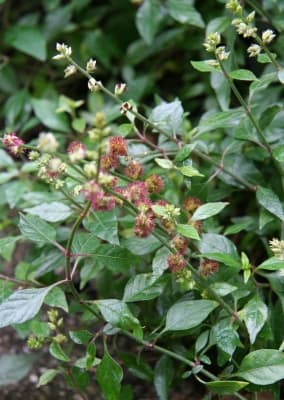
Amaranthaceae FAMILY
Pupalia lappacea
Pupalia lappacea
Edibility
1/5
Medicinal
2/5
Safety & Hazards
The plant has a burred seed-head which attaches itself to animals and is thus transported to new sites. The reflexed hooks on the spines of the seed-coat can get fixed in the mouth and throat, causing choking[1]. The flower-head is an ingredient of a rat-poison in Nigeria, but in what way it is used is not described[1].
Cultivation Details
HabitAnnual/Perennial
Growth—
The plant is seen as a serious weed within its native range[2]. The spiny, seed-containing burrs easily catch on passing animals, including people, and thus spread the plant to new locations[2].
Propagation
Seed - Cite as: Tropical Plants Database, Ken Fern. tropical.theferns.info. 2026-02-20. <tropical.theferns.info/viewtropical.php?id=Pupalia+lappacea>
Pollinators
Data unavailable
References
- [1]The Useful Plants of West Tropical Africa. — Burkil. H. M. · Royal Botanic Gardens; Kew. · 1985 - 2004 ↩︎Brief descriptions and details of the uses of over 4,000 plants. A superb, if terse, resource, it is also available electronically on the Web - see http://www.aluka.org/
- [2]Edible Wild Plants of Tanzania — Ruffo, C.K.: Birnie, A. & Tengnas, B. · Regional Land Management Unit; Nairobi. · 2002 · ISBN 9966-896-60-0 ↩︎A very well presented, simple guide to growing and utilizing wild food plants in Tanzania, with line drawings of each plant, a description, habitat and range, non-food as well as food uses, plus basic information on growing the plants.
- [3]Flora Zambesiaca — http://apps.kew.org/efloras/fz/intro.html ↩︎An excellent online flora of plants from the Zambezi River basin. It lists a number of the plant uses as well as the habitats and botanical descriptions of the plants.
- [4]Flora Malesiana Series 1 — Various · Nationaal Herbarium Nederiand, Universiteit Leiden branch · http://www.archive.org ↩︎A massive treatment of the plants of the Malaysian Archipelago. Much of it has been made available to download from the Internet
- [5]Flowers of India — http://www.flowersofindia.net/ ↩︎A wed site of native Indian plants, plus cultivated and naturalized species. It has good quality photos and terse details on more than 3,000 species and cultivars.