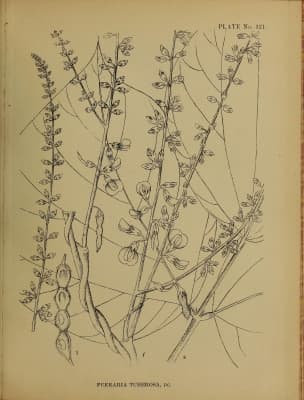
Pueraria tuberosa
Pueraria tuberosa
Safety & Hazards
Although this species is reported to have an edible root, there are said to be certain forms of the plant where the root is not considered to be edible and is instead used as a fish poison[1].
Cultivation Details
Pueraria tuberosa is native to mainly sub-tropical regions in the lower elevations of the Himalayas, though it can be found at elevations up to 2,000 metres. It is unlikely to experience much frost, except at the higher parts of its range. Requires a sunny position in a well-drained soil[2]. This species has a symbiotic relationship with certain soil bacteria, these bacteria form nodules on the roots and fix atmospheric nitrogen. Some of this nitrogen is utilized by the growing plant but some can also be used by other plants growing nearby[2].
Propagation
Pre-soak the seed for 12 hours in warm water and sow in a warm greenhouse in early spring. Germination should take place within 2 weeks. Prick out the seedlings into individual pots when they are large enough to handle and plant them out after the last expected frosts[2]. Cover the young plants with a frame or cloche until they are growing away well. Cite as: Temperate Plants Database, Ken Fern. temperate.theferns.info. 2026-02-21. <temperate.theferns.info/plant/Pueraria+tuberosa>
Pollinators
Insects
References
- [1]Revision of the Genus Pueraria DC., with some notes on Teyleria Backer — Ven der Maesen L.J.G. · Agricultural University,Wageningen,theNetherlands · 1985 · ISBN 90-6754-066-8 ↩︎
- [2]The New RHS Dictionary of Gardening. 1992. — Huxley. A. · MacMillan Press · 1992 · ISBN 0-333-47494-5 ↩︎Excellent and very comprehensive, though it contains a number of silly mistakes. Readable yet also very detailed.
- [3]Flowers of the Himalayas. — Polunin. O. and Stainton. A. · Oxford Universtiy Press · 1984 · ISBN - ↩︎A very readable and good pocket guide (if you have a very large pocket!) to many of the wild plants in the Himalayas. Gives many examples of plant uses.
- [4]Sturtevant's Edible Plants of the World. — Hedrick. U. P. · Dover Publications · 1972 · ISBN 0-486-20459-6 ↩︎Lots of entries, quite a lot of information in most entries and references.
- [5]Tanaka's Cyclopedia of Edible Plants of the World. — Tanaka. T. & Nakao S. · Keigaku Publishing; Tokyo · 1976 · ISBN - ↩︎The most comprehensive list of edible plants I've come across. Only the briefest entry for each species, though, and some of the entries are more than a little dubious. Not for the casual reader.
- [6]A Manual of Indian Timbers. — Gamble. J. S. · Bishen Singh Mahendra Pal Singh · 1972 · ISBN - ↩︎First written in the 19th century, but still a classic, giving a lot of information on the uses and habitats of Indian trees. Not for the casual reader.
- [7]Forest Flora of Chakrata, Dehra Dun and Saharanpur. — Gupta. B. L. · Forest Research Institute Press · 1945 · ISBN - ↩︎A good flora for the middle Himalayan forests, sparsly illustrated. Not really for the casual reader.
- [8]Glossary of Indian Medicinal Plants (Including the Supplement). — Chopra. R. N., Nayar. S. L. and Chopra. I. C. · Council of Scientific and Industrial Research, New Delhi. · 1986 · ISBN - ↩︎Very terse details of medicinal uses of plants with a wide range of references and details of research into the plants chemistry. Not for the casual reader.
- [9]World Agroforesty Centre — http://www.worldagroforestry.org/ ↩︎An excellent online database of a huge range of trees giving very good information on each plant - its uses, ecology, identity, propagation, pests etc.
- [PFAF]Plants for a Future — pfaf.org ↩︎