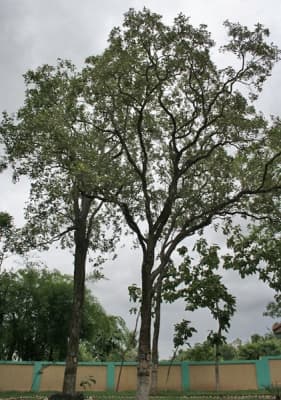
Pterocarpus santalinus
Pterocarpus santalinus
Safety & Hazards
None known
Cultivation Details
Pterocarpus santalinus is a tree of tropical areas with a distinct dry season, where it is found at elevations from 150 - 1,000 metres[1]. It grows best in areas where the mean annual temperature is within the range 26 - 32°c, but can tolerate 7 - 46°c[1]. It is killed by temperatures falling below 0°c[1]. It prefers a mean annual rainfall of 1,000 - 1,900mm, tolerating 875 - 2,800mm[1]. Grows best in a sunny position[1]. Prefers a medium to light, acid soil, succeeding in soils of low fertility[1]. Prefers a pH in the range 5 - 5.5, but tolerates 4.5 - 6.5[1]. natural fruit set is a consequence of pollinator activity The pollination ecology is vulnerable to the dry and hot conditions of the tree's native habitat, with most pollinator activity occurring.during moonlit night and early morning hours. Self-compatibility through geitonogamy is virtually inevitable in order for the species to produce fruits in situations when pollinators are scarce[2]. The shoots of young trees usually die off each year in the hot, dry season, though the roots increase in size[3]. Eventually the shoots become strong enough to withstand the hot, dry winds and the plant then develops into a tree[3]. The trees mature and are cut when around 100-120 years old[1]. The trees respond well to coppicing, and also produce suckers[3]. A coppice rotation of about 40 years is often practiced, though in some areas the tree is only allowed to grow for 3 years before being coppiced and the dye extracted[1]. This species has a symbiotic relationship with certain soil bacteria, these bacteria form nodules on the roots and fix atmospheric nitrogen. Some of this nitrogen is utilized by the growing plant but some can also be used by other plants growing nearby[4].
Propagation
Seed - Cite as: Tropical Plants Database, Ken Fern. tropical.theferns.info. 2026-02-20. <tropical.theferns.info/viewtropical.php?id=Pterocarpus+santalinus>
Pollinators
Bees
References
- [1]Ecocrop — http://ecocrop.fao.org/ecocrop/srv/en/home ↩︎Basic information on a wide range of useful plants, plus details of environmental needs where available.
- [2]A Review on Pterocarpus santalinus Linn — Azamthulla M. et al · 2015 · ISBN 2277-7105 ↩︎
- [3]A Manual of Indian Timbers. — Gamble. J. S. · Bishen Singh Mahendra Pal Singh · 1972 · ISBN - ↩︎First written in the 19th century, but still a classic, giving a lot of information on the uses and habitats of Indian trees. Not for the casual reader.
- [4]The New RHS Dictionary of Gardening. 1992. — Huxley. A. · MacMillan Press · 1992 · ISBN 0-333-47494-5 ↩︎Excellent and very comprehensive, though it contains a number of silly mistakes. Readable yet also very detailed.
- [5]The Hongmu Challenge; A briefing for the 66th meeting of the CITES Standing Committee, January 2016 — Environmental Investigation Agency; London · 2016 · http://www.eia-global.org ↩︎Lists the 33 species used in making Hungmu furniture and the degree of over-exploitation plus recommendations for protecting them.
- [6]Mansfeld's Database of Agricultural and Horticultural Plants — http://mansfeld.ipk-gatersleben.de/pls/htmldb_pgrc/f?p=185:3:4292127278597336 ↩︎Terse details of a huge range of useful plants.
- [7]Trade in Indian Medicinal Plants — D.K.Ved, S.Noorunnisa Begum, & K.Ravi Kumar · Apple Academic Press; Oakville, Canada · 2018 · ISBN 978-1-77188-600-0 ↩︎
- [8]IUCN Red List of Threatened Species — http://www.iucnredlist.org/ ↩︎A list of plants under threat and facing possible extinction, usually with brief details of the threats and information on habitat.
- [9]Cornucopia II — Facciola. S. · Kampong Publications, California. · 1998 · ISBN 0-9628087-2-5 ↩︎The second edition of an excellent guide to the edible uses of plants, though it does not give any details of cultivation etc.
- [10]Tropical and Subtropical Trees - A Worldwide Encyclopaedic Guide. — Barwick. M. · Thames & Hudson, London · 2004 · ISBN 0-500-51181-0 ↩︎A superb book, very concise and well written, giving a wealth of information on 400 or more species including descriptions, habitat, cultivation details and plant uses. A wealth of colour photographs bring each plant vividly to life.
- [11]Handbook of Ayurvedic Medicinal Plants — Kapoor. L. D. · CRC Press, Florida. · 2001 · ISBN 0-8493-2929-9 ↩︎A very detailed book on some of the key Ayurvedic herbs, giving both technical and non-technical information on each plant. The whole is very well referenced.
- [12]Useful Fiber Plants of the World — Dodge C.R. · USDA; Washington. · 1897 · http://www.biodiversitylibrary.org/ ↩︎A rather dated, but very comprehensive catalogue of fibre plants from around the world. The book can be downloaded from the Internet.
- [13]CosIng — http://ec.europa.eu/growth/tools-databases/cosing/ ↩︎CosIng is the European Commission database for information on cosmetic substances and ingredients.
- [14]Dictionary of Economic Plants. — Uphof. J. C. Th. · Weinheim · 1959 · ISBN - ↩︎An excellent and very comprehensive guide but it only gives very short descriptions of the uses without any details of how to utilize the plants. Not for the casual reader.