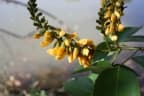
Pterocarpus santalinoides
Pterocarpus santalinoides
Safety & Hazards
Raw seeds are toxic[1].
Cultivation Details
The plant occurs in lowland regions of the moist tropics at elevations from 200 - 500 metres. It is found in regions with a mean annual temperature of around 26°c and an annual rainfall of about 1,600mm[299. 303]. It is often locally common, and sometimes even occurs gregariously[1]. The plant tolerates shade[1]. Prefers a well-drained soil[2]. It has performed well on highly acidic and aluminium toxic soils[1]. It may survive dry periods of over 5 months provided that the roots can reach the ground water, and is also tolerant of seasonal waterlogging of the soil[1]. A fast-growing tree - in southern Cameroon the fastest growing trees reached a height of 6.4 metres and a diameter of 10.3cm 20 months after planting[1]. Trees can be managed by pollarding, coppicing and lopping[1]. This species has a symbiotic relationship with certain soil bacteria; these bacteria form nodules on the roots and fix atmospheric nitrogen. Some of this nitrogen is utilized by the growing plant but some can also be used by other plants growing nearby[1].
Propagation
Seed - it has a hard seedcoat and may benefit from scarification before sowing in order to speed up and improve germination. This can usually be done by pouring a small amount of nearly boiling water on the seeds (being careful not to cook them!) and then soaking them for 12 - 24 hours in warm water. By this time they should have imbibed moisture and swollen - if they have not, then carefully make a nick in the seedcoat (being careful not to damage the embryo) and soak for a further 12 hours before sowing[1]. Germination starts after 7 - 14 days, with around 70% of the seed sprouting[1]. Dry seeds can be stored for longer periods[1]. Stem cuttings. Root cuttings. Cite as: Tropical Plants Database, Ken Fern. tropical.theferns.info. 2026-02-20. <tropical.theferns.info/viewtropical.php?id=Pterocarpus+santalinoides>
Pollinators
Bees
References
- [1]Protabase - Plant Resources of Tropical Africa. — http://www.prota.org ↩︎An excellent on-line database with detailed information on over 3,200 species of useful plants of Africa.
- [2]World Agroforesty Centre — http://www.worldagroforestry.org/ ↩︎An excellent online database of a huge range of trees giving very good information on each plant - its uses, ecology, identity, propagation, pests etc.
- [3]African Flowering Plants Database — Conservatoire et Jardin Botaniques. · http://www.ville-ge.ch/musinfo/bd/cjb/africa/recherche.php ↩︎Contains information on over 150,000 plant names (including synonyms) giving a description and habitat, plus a distribution map.
- [4]IUCN Red List of Threatened Species — http://www.iucnredlist.org/ ↩︎A list of plants under threat and facing possible extinction, usually with brief details of the threats and information on habitat.