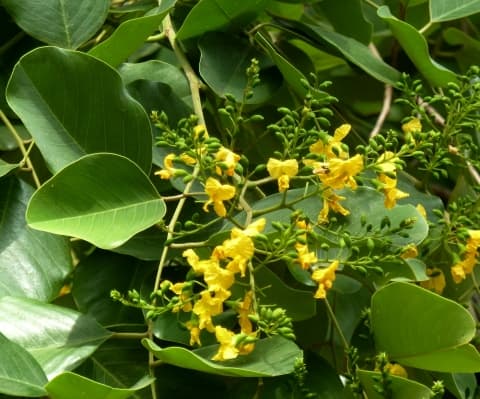
Pterocarpus rotundifolius
Pterocarpus rotundifolius
Safety & Hazards
None known
Cultivation Details
Found in drier to moist areas of the tropics and subtropics, it grows well in areas with summer rainfall and temperatures in the region of 20 - 35°c[1]. Young trees are rather sensistive to frost, but become more tolerant as they grow larger (2.5 metres or more tall)[1]. In a study in South Africa, the tree preferred clayey, medium-leached, acid, non-sodic soils with low conductivity, but in many areas it is common on deep sandy soils[2, 3]. Established plants are drought tolerant[3]. Seedlings grow fairly fast and may reach 1 metre tall after one year[2]. Young plants should be protected against cold winds for the first two years and from browsing animals, since overgrazing causes coppicing[3]. Trees can commence flowering when very young[3]. They usually flower in the rainy season, but during hot and dry weather the flower buds remain closed. Flowering is often very profuse. The strongly fragrant flowers last 2 - 3 days and are commonly visited by bees, which probably act as pollinators[2]. Trees in S. Africa burn very easily in bush fires[1]. In Mozambique, however, they were found to be fire-tolerant[2]. Trees respond well to coppicing[2]. This species has a symbiotic relationship with certain soil bacteria; these bacteria form nodules on the roots and fix atmospheric nitrogen. Some of this nitrogen is utilized by the growing plant but some can also be used by other plants growing nearby[4].
Propagation
Seed - it has a hard seedcoat and may benefit from scarification before sowing in order to speed up and improve germination. This can usually be done by pouring a small amount of nearly boiling water on the seeds (being careful not to cook them!) and then soaking them for 12 - 24 hours in warm water. By this time they should have imbibed moisture and swollen - if they have not, then carefully make a nick in the seedcoat (being careful not to damage the embryo) and soak for a further 12 hours before sowing. Seeds are often infested by insects; infested seeds should be removed before sowing. It is recommended that sowing be done in a mixture of sand and sieved compost (2:1), and seedlings with one leaf should be transplanted in planting bags filled with a sand-based, well-drained growth medium. Care should be taken to avoid damage to the taproot[2]. Large stem cuttings (2 - 3 metres long and about 10cm in diameter) planted in holes filled with sand have been used for propagation; they showed a high survival rate[2]. Cite as: Tropical Plants Database, Ken Fern. tropical.theferns.info. 2026-02-20. <tropical.theferns.info/viewtropical.php?id=Pterocarpus+rotundifolius>
Pollinators
Bees, Wasps
References
- [1]PlantZAfrica.com — http://www.plantzafrica.com ↩︎An excellent site giving detailed descriptions and uses of many S. African plants.
- [2]Protabase - Plant Resources of Tropical Africa. — http://www.prota.org ↩︎An excellent on-line database with detailed information on over 3,200 species of useful plants of Africa.
- [3]World Agroforesty Centre — http://www.worldagroforestry.org/ ↩︎An excellent online database of a huge range of trees giving very good information on each plant - its uses, ecology, identity, propagation, pests etc.
- [4]Nodulation Plants in GRIN Taxonomy — United States Department of Agriculture · http://www.ars-grin.gov/~sbmljw/cgi-bin/taxnodul.pl?language=en ↩︎An online database listing plants that have either positive or negative reports on root and stem nodulation with nitrogen-fixing bacteria.
- [5]African Flowering Plants Database — Conservatoire et Jardin Botaniques. · http://www.ville-ge.ch/musinfo/bd/cjb/africa/recherche.php ↩︎Contains information on over 150,000 plant names (including synonyms) giving a description and habitat, plus a distribution map.
- [6]Useful Plants of Nyasaland — Williamson J. · The Government Printer, Zomba, Nyasaland. · 1955 · http://www.biodiversitylibrary.org ↩︎Brief details of the uses of almost 500 species of plants.