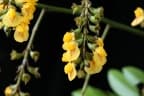
Pterocarpus officinalis
Pterocarpus officinalis
Safety & Hazards
None known
Cultivation Details
A plant of mainly lowland areas of the moist to wet tropics, usually found at elevations below 350 metres, but occasionally to 800 metres. The seeds are dispersed by water currents[1]. This species is one of several that supply a red resin from their stem. This resin, often known as 'Dragon's Blood' is often used as an external application to treat a range of skin problems and injuries[2]. Dragon's Blood can be obtained from several species in this genus, as well as from three other distinct genera - Dracaena species, Croton species and Daemonorops species[2] This species has a symbiotic relationship with certain soil bacteria, these bacteria form nodules on the roots and fix atmospheric nitrogen. Some of this nitrogen is utilized by the growing plant but some can also be used by other plants growing nearby[3].
Propagation
Seed - Cite as: Tropical Plants Database, Ken Fern. tropical.theferns.info. 2026-02-20. <tropical.theferns.info/viewtropical.php?id=Pterocarpus+officinalis>
Pollinators
Bees, Butterflies, Insects
References
- [1]Tree Species of Panama — http://ctfs.arnarb.harvard.edu/webatlas/mainframe.php?order=s ↩︎Factsheets on all the tree and shrub species of Panama, giving identification guide, brief guide to the species and some uses. A vast, but rather incomplete work as of 15/07/09.
- [2]A Systematic Review of the Botanical, Phytochemical and Pharmacological Profile of Dracaena cochinchinensis, a Plant — Jia-Yi Fan et al · 2014 · http://10.3390/molecules190710650 · ISBN 1420-3049 ↩︎
- [3]The New RHS Dictionary of Gardening. 1992. — Huxley. A. · MacMillan Press · 1992 · ISBN 0-333-47494-5 ↩︎Excellent and very comprehensive, though it contains a number of silly mistakes. Readable yet also very detailed.
- [4]Flora of Barro Colorado Island — Croat. Thomas B. · Stanford University Press · 1978 · http://biogeodb.stri.si.edu/bioinformatics/croat/home · ISBN 0-8047-0950-5 ↩︎A very good flora of an area in Panama. Written some years ago, so some of the names have been changed. The book is out of print, but the whole flora is now available on the web.
- [5]South American Timbers: the Properties, Uses and Characteristics of 190 Species. — Bolza. E. & Christensen. F.J. · Commonwealth Scientific and Industrial Research Organization · 1979 · ISBN 0 643 02582 0 ↩︎A very useful guide.
- [6]Mansfeld's Database of Agricultural and Horticultural Plants — http://mansfeld.ipk-gatersleben.de/pls/htmldb_pgrc/f?p=185:3:4292127278597336 ↩︎Terse details of a huge range of useful plants.
- [7]Flora Medica — Lindley J. · Longman, Orme, Brown, Green and Longmans: London · 1838 · http://www.biodiversitylibrary.org/ ↩︎A massive work - many of the botanical names have changed, but the book is still a wealth of information.
- [8]Common Trees of Puerto Rico and the Virgin Islands — Little E.L.; Wadsworth F.H. · USDA, Forest Service; Washington. · 1964 ↩︎Contains detailed information, and usually an illustration, on 250 tree species, including both native and exotic species.
- [9]Medicinal Plants of the Guianas — DeFilipps, R. A.; Maina, S. L.; & Crepin, J. · Smithsonian Museum · http://botany.si.edu/bdg/medicinal/index.html ↩︎A down-loadable PDF document of a book in pre-publication awaiting illustration. An excellent, if rather terse, guide to the traditional medicinal uses of the plants of the region
- [10]Plants of Haiti used as Antifertility Agents — Weniger B. et al · 1982 · ISBN 0378-8741 ↩︎
- [11]Trees and Shrubs of Mexico — Standley P.C. · Smithsonian Institution; Washington · 1926 ↩︎Although dated, it contains a wealth of information on the trees and shrubs of Mexico, including many of their uses. It can be downloaded from the Internet.
- [12]Annals of the Missouri Botanical Gardens Vol. 52 — Missouro Botanical Garden · 1965 ↩︎An excellent botanical publication, available for download from the Internet. Amongst other things, this issue contains parts of the Flora of Panama.