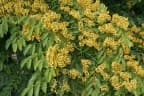
Pterocarpus macrocarpus
Pterocarpus macrocarpus
Safety & Hazards
None known
Cultivation Details
A tree of mainly lowland tropical areas, where it ca be found at elevations up to 850 metres[1]. It grows best in areas where the mean annual temperature falls within the range 24 - 34°c, but can tolerate 8 - 44°c[1]. Plants are not tolerant of frost[2]. It prefers a mean annual rainfall of 1,500 - 2,500mm,tolerating 875 - 5,000mm[1]. Grows best in a sunny position[2, 1]. Requires a well-drained soil, preferring a sandy loam[2]. Prefers a pH in the range 5.5 - 6.5, but tolerates 5 - 7.5[1]. Succeeds in neutral to strongly acid soils[3]. Young plants establish fairly well - seedlings in plantations grew from 0.6 to 1.2 metres in their first year and added another 1.2 - 2.1 metres in their second[3]. In Puerto Rico, 30 planted trees in a small forest plantation that was situated on clay soil over porous limestone averaged 1.3 metres in height 14 months after planting out[3]. Flowering and fruiting usually begins in open-grown trees between 5 and 10 years of age[3]. Closely related to P. Indicus[3]. This species has a symbiotic relationship with certain soil bacteria, these bacteria form nodules on the roots and fix atmospheric nitrogen. Some of this nitrogen is utilized by the growing plant but some can also be used by other plants growing nearby[4].
Propagation
Seed - usually sown whilst still in the seedpod[3]. It can be sown without pre-treatment[3], but pre-soaking for 12 - 24 hours in warm water at a temperature of about 35 - 40°c can speed up the germination process[2]. Sow the seed in nursery seed beds or containers[3]. Germination commences after about 11 days, with about 64% of the seed germinating[2]. If the seeds are extracted from the pods first (a very labour intensive operation), then germination begins after 5 days with about 70% of seeds germinating[2]. Pot up the seedlings when the first true leaves develop[3]. Seedlings can be planted out into their permanent positions when about 1 year old and around 30cm tall[2]. Seeds can be stored for several years. Indeed, seeds from pods that had lain on the ground for 1 year germinated better than new pods collected from the tree[3]. Cite as: Tropical Plants Database, Ken Fern. tropical.theferns.info. 2026-02-20. <tropical.theferns.info/viewtropical.php?id=Pterocarpus+macrocarpus>
Pollinators
Data unavailable
References
- [1]Ecocrop — http://ecocrop.fao.org/ecocrop/srv/en/home ↩︎Basic information on a wide range of useful plants, plus details of environmental needs where available.
- [2]Seed Leaflets — Various · Forest & Landscape. Denmark · http://en.sl.life.ku.dk/Publikationer/Udgivelser/PopulaerPublikationer.aspx?katid={D28373CC-6EF3-4EF8-B097-6D83FABF209E}&serieid={9F1C3DB1-6E7B-4CF1-AF53-F480B0CB40EF}&sort=title ↩︎A series of leaflets, jointly produced by the University of Copenhagen and the Royal Botanic Gardens at Kew, focussing on seed information for a number species, but also giving a lot of other information about each plant.
- [3]Tropical Tree Seed Manual — Vosso. J. Editor. · USDA Forest Service. · 2002 · http://www.rngr.net/Publications/ttsm ↩︎An extremely good guide, it can also be downloaded in its entirety from the address shown above.
- [4]The New RHS Dictionary of Gardening. 1992. — Huxley. A. · MacMillan Press · 1992 · ISBN 0-333-47494-5 ↩︎Excellent and very comprehensive, though it contains a number of silly mistakes. Readable yet also very detailed.
- [5]Tropical Timbers of the World. Ag. Handbook No. 607. — Chudnoff. Martin. · USDA Forest Service. Wisconsin. · 1984 ↩︎Terse details on the properties of the wood of almost 400 species of trees from the Tropics.
- [6]Trees of Laos and Vietnam - A Field Guide to 100 species. — Hoang Van Sam; Khamseng Nanthavong; Kessler P.J.A. · Blumea · 2004 ↩︎A detailed guide, with excellent line-drawings, to 100 of the more important trees of Laos and Vietnam. A very good work, giving lots of information about each plant. Originally published in the journal Blumea, it is available as a PDF on the Interne
- [7]The Hongmu Challenge; A briefing for the 66th meeting of the CITES Standing Committee, January 2016 — Environmental Investigation Agency; London · 2016 · http://www.eia-global.org ↩︎Lists the 33 species used in making Hungmu furniture and the degree of over-exploitation plus recommendations for protecting them.
- [8]Forest Restoration Planting in Northern Thailand — Pakkad G.; Elliott S.; Anusarnsunthorn V. Et al · Food and Agriculture Organization of the United Nations; Bangkok · 2002 · http://www.fao.org/ ↩︎A report on reforestation in northern Thailand by using specific pioneer species. It can be downloaded from the Internet.
- [9]Dictionary of Economic Plants. — Uphof. J. C. Th. · Weinheim · 1959 · ISBN - ↩︎An excellent and very comprehensive guide but it only gives very short descriptions of the uses without any details of how to utilize the plants. Not for the casual reader.
- [10]A Manual of Indian Timbers. — Gamble. J. S. · Bishen Singh Mahendra Pal Singh · 1972 · ISBN - ↩︎First written in the 19th century, but still a classic, giving a lot of information on the uses and habitats of Indian trees. Not for the casual reader.