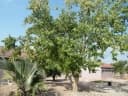
Pterocarpus lucens
Pterocarpus lucens
Safety & Hazards
The sawdust may cause irritation in workers[1].
Cultivation Details
Pterocarpus lucens is a plant of the savannah regions of the tropics, where it is found at elevations of 550 - 1,520 metres[2]. Up to 3,000 metres[3]. It grows best in areas where the mean annual temperature is within the range 15 - 32°c, but is tolerant of 12 - 40°c[2]. It prefers a mean annual rainfall in the range 400 - 700mm, but tolerates 250 - 900mm[2]. Requires a sunny position[2]. Prefers a deep, sandy soil, but can also succeed on clay, stony and gravely soils[1, 3]. Prefers a pH in the range 5.5 - 7, tolerating 5 - 7.5[2]. The roots have nodules containing nitrogen-fixing bacteria, but this species is considered to have comparatively low nitrogen fixation potential[1].
Propagation
Seed - pre-soaking the seed for 12 - 24 hours in warm water is likely to improve germination rates. If the seed has not swollen after this, then carefully scarify it to allow the ingress of moisture by making a small hole in the seed coat without damaging the embryo[4]. Optimum temperatures for germination are in the range of 25 - 35°c[1]. Sow the seed in a sunny position, either in nursery beds or in pots. Scarified seed germinates well in 3 - 4 weeks[4]. The dried seeds can be stored for up to 4 years under favourable conditions[3]. Cite as: Tropical Plants Database, Ken Fern. tropical.theferns.info. 2026-02-20. <tropical.theferns.info/viewtropical.php?id=Pterocarpus+lucens>
Pollinators
Bees
References
- [1]Protabase - Plant Resources of Tropical Africa. — http://www.prota.org ↩︎An excellent on-line database with detailed information on over 3,200 species of useful plants of Africa.
- [2]Ecocrop — http://ecocrop.fao.org/ecocrop/srv/en/home ↩︎Basic information on a wide range of useful plants, plus details of environmental needs where available.
- [3]World Agroforesty Centre — http://www.worldagroforestry.org/ ↩︎An excellent online database of a huge range of trees giving very good information on each plant - its uses, ecology, identity, propagation, pests etc.
- [4]Seed Leaflets — Various · Forest & Landscape. Denmark · http://en.sl.life.ku.dk/Publikationer/Udgivelser/PopulaerPublikationer.aspx?katid={D28373CC-6EF3-4EF8-B097-6D83FABF209E}&serieid={9F1C3DB1-6E7B-4CF1-AF53-F480B0CB40EF}&sort=title ↩︎A series of leaflets, jointly produced by the University of Copenhagen and the Royal Botanic Gardens at Kew, focussing on seed information for a number species, but also giving a lot of other information about each plant.
- [5]African Flowering Plants Database — Conservatoire et Jardin Botaniques. · http://www.ville-ge.ch/musinfo/bd/cjb/africa/recherche.php ↩︎Contains information on over 150,000 plant names (including synonyms) giving a description and habitat, plus a distribution map.
- [6]IUCN Red List of Threatened Species — http://www.iucnredlist.org/ ↩︎A list of plants under threat and facing possible extinction, usually with brief details of the threats and information on habitat.
- [7]Trees and Shrubs of the Sahel. Their Characteristics and Uses. — von Maydell H. · Deutsche Gesellschaft fur Technische Zusammenarbeit; Germany · 1990 · ISBN 3-8236-1198-4 ↩︎A well-researched book, usually with more than one photograph of each species and good information on the plant and its uses.