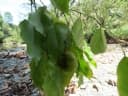
Pterocarpus indicus
Pterocarpus indicus
Safety & Hazards
None known
Cultivation Details
A plant of the moist to wet tropics, where it is found at elevations up to 750 metres, though it can be cultivated at higher elevations[1]. It grows best in areas where annual daytime temperatures are within the range 24 - 32°c, but can tolerate 12 - 37°c[2]. The plant is not frost tolerant.. It prefers a mean annual rainfall in the range 2,000 - 3,000mm, but tolerates 1,500 - 3,500mm[2]. Amboyna behaves like a pioneer and grows best in an open position[3]. Succeeds in a range of soils from sandy loams to clays with a pH from neutral to very strongly acid[4]. Prefers a fertile, moisture-retentive soil[5]. Tolerates moderate levels of salt in the soil[2]. Prefers a pH in the range 5.5 - 6.5, tolerating 5 - 7.5[2]. As an urban tree, amboyna is relatively wind-firm and seldom suffers branch breakage. Under favourable conditions, trees in Singapore have been known to grow an average of 33 metres in height and 1.55 metres in girth in 11 years, or an average annual increment of 1.2 metres height and 14 cm girth[3]. Open-grown trees usually begin flowering and fruiting between 5 and 10 years of age[4]. Plants can flower and produce fruit all year round[6]. The roots can become quite large and grow near the surface, the tree should therefore be planted several metres away from sidewalks and other structures[4]. Seedlings are slower growing than cuttings and exhibit considerable variation in vigour. A strict culling program would be necessary to ensure that only the best stocks are planted out[3]. Rooted cuttings can be established readily on nearly all kinds of soils, from coastal sands to inland clays, in urban and garden situations, and even in quite small planting holes dug into pavements. However, establishment trials in forest areas have had mixed results and some have failed[3]. The reasons are not clear[3]. Trees of all sizes and ages easily regenerate new shoots when lopped or pollarded[3]. In Papua New Guinea, logged forest trees readily regenerate new plants from the roots[3]. This species has a symbiotic relationship with certain soil bacteria, these bacteria form nodules on the roots and fix atmospheric nitrogen. Some of this nitrogen is utilized by the growing plant but some can also be used by other plants growing nearby[7].
Propagation
Seed - easy[1]. No pre-germination treatment is necessary[4]. Because shelling the fragile seeds from the tough pods is difficult by hand and currently impossible mechanically, pods are sown with the seeds inside[4]. Germination rates between 24 - 57% have been recorded, with the first seeds germinating after 5 days and the last after 3 months[4]. Pods are lightly covered with potting mixture in germination beds or trays and kept moist until germination. Planting seeds with the pods requires thinning the plants soon after emergence. When true leaves develop, the seedlings are transplanted into nursery bags or pots filled with a potting mixture. Seedlings about 50cm in height are suitable for most forestry plantings[4]. Air-dried seeds in their pods will still germinate after 1 year of storage at room temperature[4]. Cuttings of the species can be rooted. In the Philippines, branch cuttings of P. Indicus about 8 cm in diameter are rooted after hormone treatment to produce instant trees[4]. Cite as: Tropical Plants Database, Ken Fern. tropical.theferns.info. 2026-02-20. <tropical.theferns.info/viewtropical.php?id=Pterocarpus+indicus>
Pollinators
Honey bees, Insects
References
- [1]Global Tree Campaign - 40 Species in Trade — http://www.unep-wcmc.org/trees/trade/40_species_in_trade.htm ↩︎Information on the habitats, uses and some cultivation notes for 40 species of timber trees.
- [2]Ecocrop — http://ecocrop.fao.org/ecocrop/srv/en/home ↩︎Basic information on a wide range of useful plants, plus details of environmental needs where available.
- [3]World Agroforesty Centre — http://www.worldagroforestry.org/ ↩︎An excellent online database of a huge range of trees giving very good information on each plant - its uses, ecology, identity, propagation, pests etc.
- [4]Tropical Tree Seed Manual — Vosso. J. Editor. · USDA Forest Service. · 2002 · http://www.rngr.net/Publications/ttsm ↩︎An extremely good guide, it can also be downloaded in its entirety from the address shown above.
- [5]Tropical and Subtropical Trees - A Worldwide Encyclopaedic Guide. — Barwick. M. · Thames & Hudson, London · 2004 · ISBN 0-500-51181-0 ↩︎A superb book, very concise and well written, giving a wealth of information on 400 or more species including descriptions, habitat, cultivation details and plant uses. A wealth of colour photographs bring each plant vividly to life.
- [6]Medicinal Plants in Papua New Guinea — World Health Organisation · 2009 · ISBN 978-92-9061-249-0 ↩︎Traditional medicinal uses of 126 species from Papua New Guinea, including information on modern research into the plants.
- [7]The New RHS Dictionary of Gardening. 1992. — Huxley. A. · MacMillan Press · 1992 · ISBN 0-333-47494-5 ↩︎Excellent and very comprehensive, though it contains a number of silly mistakes. Readable yet also very detailed.
- [8]Seed Leaflets — Various · Forest & Landscape. Denmark · http://en.sl.life.ku.dk/Publikationer/Udgivelser/PopulaerPublikationer.aspx?katid={D28373CC-6EF3-4EF8-B097-6D83FABF209E}&serieid={9F1C3DB1-6E7B-4CF1-AF53-F480B0CB40EF}&sort=title ↩︎A series of leaflets, jointly produced by the University of Copenhagen and the Royal Botanic Gardens at Kew, focussing on seed information for a number species, but also giving a lot of other information about each plant.
- [9]The Hongmu Challenge; A briefing for the 66th meeting of the CITES Standing Committee, January 2016 — Environmental Investigation Agency; London · 2016 · http://www.eia-global.org ↩︎Lists the 33 species used in making Hungmu furniture and the degree of over-exploitation plus recommendations for protecting them.
- [10]IUCN Red List of Threatened Species — http://www.iucnredlist.org/ ↩︎A list of plants under threat and facing possible extinction, usually with brief details of the threats and information on habitat.
- [11]Cornucopia II — Facciola. S. · Kampong Publications, California. · 1998 · ISBN 0-9628087-2-5 ↩︎The second edition of an excellent guide to the edible uses of plants, though it does not give any details of cultivation etc.