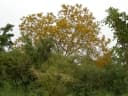
Pterocarpus erinaceus
Pterocarpus erinaceus
Safety & Hazards
None known
Cultivation Details
A plant of semi-arid to sub-humid tree savannah in the tropics, where it is usually found at elevations up to 600 metres, exceptionally to 1,200 metres[1]. It grows best in areas with a mean annual temperature of 15 - 32°c[1]. It prefers a mean annual rainfall of 600 - 1,200mm, but can tolerate up to 1,600mm annual rainfall. It can tolerate up to 4,000mm of rain[2]. It grows naturally in areas with a long dry season of up to 9 months[1]. Requires a sunny position[3]. Tolerant of most soil types, but prefers a light to medium, free-draining, acid to neutral soil[1]. Succeeds on poor shallow soils, though growth is often stunted[4, 5]. Prefers a pH in the range 5 - 5.5, tolerating 4.5 - 6.5[2]. Established plants are very drought tolerant[5]. Young plants often grow away slowly, with two year old seedlings usually only reaching 42 - 100cm in height[1]. In northern Cote d'Ivoire planted seedlings had an average height of 9 cm after 3 months, 50 cm after 18 months, 2.8 metres after 2.5 years, 4.4 metres after 4.5 years and 5.5 metres after 5.5 years. The fastest growing tree was 10 metres tall after 5.5 years[1]. Trees respond well to coppicing, recovering well and growing more than 1 metre per year[1]. Coppicing at a height of 10 cm above ground has been recommended as a means of harvesting wood and fodder, but a coppicing height of 50 cm has also been recommended[1]. Trees do not resprout well when coppiced at ground level[1]l. To avoid browsing of new growth, cutting at a height of over 1.5 metres seems recommendable[1]. This species is one of several that supply a red resin from their stem. This resin, often known as 'Dragon's Blood' is often used as an external application to treat a range of skin problems and injuries[6]. Dragon's Blood can be obtained from several species in this genus, as well as from three other distinct genera - Dracaena species, Croton species and Daemonorops species[6] The flowers are much visited by bees, which are probably responsible for pollination[1]. The tree may produce so many fruits that when the fruits are green it looks as if the tree is covered with leaves[1]. Natural regeneration is often abundant and the species may be quite invasive if protected from grazing for some years[1]. The plant can survive annual bush fires[1]. The roots have nodules containing nitrogen-fixing bacteria. However, this species has low nitrogen-fixation potential in comparison with several other leguminous trees[1].
Propagation
Seed - pre-soaking in water for 12 - 24 hours, or treatment with sulphuric acid for 30 - 60 minutes improve germination rates from 50% to 70%[1]. A germination rate of 100% was achieved using mechanical scarification, sowing in 1% agar, incubation at 21°c and a 12-hour photoperiod[1]. Seeds can be sown in pots or in nursery beds at a spacing of about 20 cm × 30 cm. Germination is best at a temperature of 25 - 35°c, with the first seeds sprouting after 6 - 10 days[1]. Seedlings develop a long taproot and grow away slowly[1]. They can be planted out from pots or as bare-root plants, either as stumps or as entire seedlings. The survival rate is generally high when the seedlings are protected from livestock and wild herbivores[1]. Suckers are developed regularly and can be used for vegetative propagation[1]. Propagation by cuttings has been successful[1]. Cite as: Tropical Plants Database, Ken Fern. tropical.theferns.info. 2026-02-20. <tropical.theferns.info/viewtropical.php?id=Pterocarpus+erinaceus>
Pollinators
Bees, Insects
References
- [1]Protabase - Plant Resources of Tropical Africa. — http://www.prota.org ↩︎An excellent on-line database with detailed information on over 3,200 species of useful plants of Africa.
- [2]Ecocrop — http://ecocrop.fao.org/ecocrop/srv/en/home ↩︎Basic information on a wide range of useful plants, plus details of environmental needs where available.
- [3]Grassland Species - Profiles — http://www.fao.org/ag/AGP/AGPC/doc/Gbase/Default.htm ↩︎Terse information on over 650 species of plants that grow in grassland, including trees, shrubs and perennial plants as well as grasses. Gives a brief description of the plant, its range and habitat and some of its uses.
- [4]World Agroforesty Centre — http://www.worldagroforestry.org/ ↩︎An excellent online database of a huge range of trees giving very good information on each plant - its uses, ecology, identity, propagation, pests etc.
- [5]Forest, Farm, and Community Tree Network — http://www.winrock.org/fnrm/factnet/factnet.htm ↩︎A series of in-depth factsheets on a wide range of plants, especially leguminous trees.
- [6]A Systematic Review of the Botanical, Phytochemical and Pharmacological Profile of Dracaena cochinchinensis, a Plant — Jia-Yi Fan et al · 2014 · http://10.3390/molecules190710650 · ISBN 1420-3049 ↩︎
- [7]African Flowering Plants Database — Conservatoire et Jardin Botaniques. · http://www.ville-ge.ch/musinfo/bd/cjb/africa/recherche.php ↩︎Contains information on over 150,000 plant names (including synonyms) giving a description and habitat, plus a distribution map.
- [8]The Useful Plants of West Tropical Africa. — Burkil. H. M. · Royal Botanic Gardens; Kew. · 1985 - 2004 ↩︎Brief descriptions and details of the uses of over 4,000 plants. A superb, if terse, resource, it is also available electronically on the Web - see http://www.aluka.org/
- [9]The Hongmu Challenge; A briefing for the 66th meeting of the CITES Standing Committee, January 2016 — Environmental Investigation Agency; London · 2016 · http://www.eia-global.org ↩︎Lists the 33 species used in making Hungmu furniture and the degree of over-exploitation plus recommendations for protecting them.
- [10]Dictionary of Economic Plants. — Uphof. J. C. Th. · Weinheim · 1959 · ISBN - ↩︎An excellent and very comprehensive guide but it only gives very short descriptions of the uses without any details of how to utilize the plants. Not for the casual reader.
- [11]Tropix 7 — CIRAD · http://tropix.cirad.fr/en ↩︎An on-line guide to the timbers of 245 species of trees.