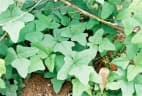
Psophocarpus scandens
Psophocarpus scandens
Safety & Hazards
None known
Cultivation Details
Psophocarpus scandens is a plant mainly of lowland tropical areas, where it can be found at elevations up to 1,000 metres[1]. It grows best in areas with a mean annual rainfall of 1,200 - 1,800mm and a mean annual temperature of 25°c[1]. Plants thrive in full sunlight, but also tolerate some shade[2]. Prefers damp sites near lakes, marshes, ponds, rivers and streams, but also occurs in drier environments[2]. It grows well on heavy, swamp soils, but has also succeeded on gley soils of low humus content, with a loamy-clay texture[2]. Early establishment of seedling plants is slow[1]. Once well established, however, growth is vigorous[2]. Flowering can commence about 115 days after sowing[2]. When grown mixed with other cover crops, this species may overgrow and suppress the companion crops within a year, remaining as the sole cover crop after two years[2]. Planted as a ground cover, the ends of the shoots rise and twine. In dense stands, they may find mutual support and intertwine, forming loose strands or conical heaps rising well above the rest of the cover crop. These heaps become top-heavy, bend and are then taken up in the cover crop[2]. The sprouts of new shoots may form similar heaps which intermingle with the older ones forming an airy, but closed soil cover[2]. Branches may root at the nodes where they touch the soil[2]. This species has a symbiotic relationship with certain soil bacteria, these bacteria form nodules on the roots and fix atmospheric nitrogen. Some of this nitrogen is utilized by the growing plant but some can also be used by other plants growing nearby[3].
Propagation
Seed - requires pre-treatment. Pre-soaking for 12 - 24 hours in warm water should soften the hard seedcoat and allow the seed to swell. If it does not swell, then making a small nick in the seedcoat (being careful not to damage the embryo) should allow the seed to take up water[PFAF]. Cite as: Tropical Plants Database, Ken Fern. tropical.theferns.info. 2026-02-20. <tropical.theferns.info/viewtropical.php?id=Psophocarpus+scandens>
Pollinators
Bees
References
- [1]Protabase - Plant Resources of Tropical Africa. — http://www.prota.org ↩︎An excellent on-line database with detailed information on over 3,200 species of useful plants of Africa.
- [2]Plant Resources of Southeast Asia — http://proseanet.org/ ↩︎Lots of information on the uses of the plants of SE Asia.
- [3]The New RHS Dictionary of Gardening. 1992. — Huxley. A. · MacMillan Press · 1992 · ISBN 0-333-47494-5 ↩︎Excellent and very comprehensive, though it contains a number of silly mistakes. Readable yet also very detailed.
- [4]Mansfeld's Database of Agricultural and Horticultural Plants — http://mansfeld.ipk-gatersleben.de/pls/htmldb_pgrc/f?p=185:3:4292127278597336 ↩︎Terse details of a huge range of useful plants.
- [5]Uses, Nutritional Composition, and Ecogeography of Four Species of Psophocarpus (Fabaceae, Phaseoleae) in Zaire — Harder D.; Lolema O.P.M. & Tshisand M. · 1990 · http://www.jstor.org/stable/4255258. ↩︎
- [PFAF]Plants for a Future — pfaf.org ↩︎