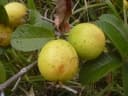
Psidium guajava
Psidium guajava
Safety & Hazards
None known
Cultivation Details
The guava is a hardy tree that adapts to a wide range of growing conditions from the humid lowland tropics to the cooler elevations, fruiting at elevations up to 1,500 metres and surviving as high as 2,000 metres[1, 2]. It can stand a wide range of temperatures; the highest yields are recorded at mean temperatures of 23 - 28°c, whilst in the subtropics quiescent trees can withstand light frost, and 3.5 - 6 months (depending on the cultivar) of mean temperatures above 16°c are sufficient for flowering and fruiting[2]. When dormant, the plant can survive temperatures down to about -5°c, but young growth can be severely damaged at -1°c[3]. It can also tolerate low to moderate rainfall levels though, for good fruiting, it requires at least 1,000mm per annum with a clear dry period to allow its fruit to ripen[1]. It prefers a mean annual rainfall in the range 1,000 - 3,000mm, but can tolerate 400 - 5,000mm[3]. For maximum production in the tropics it requires rainfall distributed over the year[2]. If fruit ripens during a very wet period it loses flavour and may split[2]. Prefers a fertile, moisture-retentive soil and a sunny position[4]. Plants are tolerant of a range of soil conditions[1]. Moderately tolerant of saline soils[5]. Prefers a pH in the range 5.5 - 7.5, tolerating 4 - 8.5[3]. The plant is more drought-resistant than most tropical fruit crops[2]. The guava often escapes from cultivation and is considered a noxious weed in many tropical pasture lands - its proliferation may result in the abandonment of a pasture[2]. There are many named varieties, selected for their superior fruit forms[6]. Plants have some deep roots, but do not form a taproot[2]. The trees flower all year round[4]. Seedlings may flower within 2 years; clonally propagated trees often begin to bear during the first year after planting[2]. Trees reach full bearing after 5 - 8 years, depending on growing conditions and spacing[2]. The guava is not a long-lived tree (about 40 years), but the plants may bear heavily for 15 - 25 years[2]. Average yields are between 30 - 40 kg/plant in 5 year-old plants and will reach a maximum production of 50 - 70 kg at about 7 years if well managed[2].
Propagation
Seed - very easy, plants will often self-sow very freely[7]. Seedlings tend to be true to their parents and can fruit within 3 years of germinating[7]. Seed can be sown in beds, pots or directly in the field at a depth of 1 cm; germination occurs within 15 - 20 days[2]. They should be planted out when about 25 cm high[2]. Air-layering. Cuttings. Grafting. Cite as: Tropical Plants Database, Ken Fern. tropical.theferns.info. 2026-02-20. <tropical.theferns.info/viewtropical.php?id=Psidium+guajava>
Pollinators
Bees, Self
References
- [1]The New RHS Dictionary of Gardening. 1992. — Huxley. A. · MacMillan Press · 1992 · ISBN 0-333-47494-5 ↩︎Excellent and very comprehensive, though it contains a number of silly mistakes. Readable yet also very detailed.
- [2]World Agroforesty Centre — http://www.worldagroforestry.org/ ↩︎An excellent online database of a huge range of trees giving very good information on each plant - its uses, ecology, identity, propagation, pests etc.
- [3]Ecocrop — http://ecocrop.fao.org/ecocrop/srv/en/home ↩︎Basic information on a wide range of useful plants, plus details of environmental needs where available.
- [4]Tropical and Subtropical Trees - A Worldwide Encyclopaedic Guide. — Barwick. M. · Thames & Hudson, London · 2004 · ISBN 0-500-51181-0 ↩︎A superb book, very concise and well written, giving a wealth of information on 400 or more species including descriptions, habitat, cultivation details and plant uses. A wealth of colour photographs bring each plant vividly to life.
- [5]Digital Compendium of Forestry Species of Cambodia — www.digitalspecies.blogspot.com; Phnom Penh · 2008 · http://www.digitalspecies.blogspot.com ↩︎A very detailed booklet, produced in PDF format on the internet, giving information on around 100 species of trees.
- [6]Cornucopia II — Facciola. S. · Kampong Publications, California. · 1998 · ISBN 0-9628087-2-5 ↩︎The second edition of an excellent guide to the edible uses of plants, though it does not give any details of cultivation etc.
- [7]Tropical Food Gardens — Norrington. L. · Bloomings Books (Melbourne) · 2001 · ISBN 1-876473-41-x ↩︎Excellent little book giving some basic information on a range of plants.
- [8]Brazilian Trees. Volume 1. 4th Edition. — Lorenzi. H. · Instituto Plantarum De Estudos Da Flora; Brazil. · 2002 · ISBN 85-86714-17-8 ↩︎Information on 350 species of Brazilian trees. Stunning photographs of each species, brief details on the plant, its uses and how to grow it from seed. A superb work, with the minor irritation that the translation from Portuguese is not of the best.
- [9]Medicinal Plants in the South Pacific — WHO Regional Publications, Manilla. · 1998 · ISBN 92-9061-118-9 ↩︎Excellent guide to 102 medicinal herbs of the Pacific Islands, with photographs of each plant and details of their constituents, biological activities and traditional uses. A description of each plant, together with habitat and distribution is given.
- [10]Plants and People of Nepal — Manandhar. N. P. · Timber Press. Oregon. · 2002 · ISBN 0-88192-527-6 ↩︎Excellent book, covering over 1,500 species of useful plants from Nepal together with information on the geography and peoples of Nepal. Good descriptions of the plants with terse notes on their uses.