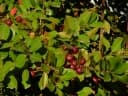
Psidium cattleianum
Psidium cattleianum
Safety & Hazards
None known
Cultivation Details
Strawberry guava can thrive in a range of conditions from the humid lowland tropics and subtropics up to elevations of 1,500 metres[1]. It grows best in areas where annual daytime temperatures are within the range 22 - 28°c, but can tolerate 9 - 32°c[1], and will succeed outdoors only in the warmest parts of the temperate zone. When dormant, the plant can survive temperatures down to about -6°c, but young growth can be severely damaged at -1°c[1]. It prefers a mean annual rainfall in the range 1,600 - 2,000mm, but tolerates 600 - 4,000mm[1]. It prefers a clear dry period to allow the fruit to ripen[2]. Plants are less likely to fruit when grown in tropical areas[3]. Succeeds in full sun and also in light shade[1]. Requires a well-drained sandy loam with leafmold[4]. Plants are tolerant of a range of soil conditions[2], and can also tolerate swampy conditions[5]. Prefers a pH in the range 5.5 - 6.5, tolerating 4.5 - 7.7[1]. Seedling plants can commence bearing fruit when only 2 - 3 years old[5]. Plants will usually flower and fruit on several occasions during the year[5]. The flowers are produced on new growth[5]. The plant is self-fertile, but crops better when cross-pollinated[6]. There are some named varieties[7, 2]. A form with red fruits, found wild on the coastal levees of Brazil, is said to have a superior flavour.
Propagation
Seed - sow spring in a warm greenhouse. When large enough to handle, prick out the seedlings into individual pots and grow them on in the greenhouse for at least their first winter. If trying the plants outdoors, plant them out in the summer and give them some protection from winter cold for at least their first two winters. Cuttings of half-ripe wood, mid summer in a frame. Cite as: Temperate Plants Database, Ken Fern. temperate.theferns.info. 2026-02-21. <temperate.theferns.info/plant/Psidium+cattleianum>
Pollinators
Insects, Self
References
- [1]Ecocrop — http://ecocrop.fao.org/ecocrop/srv/en/home ↩︎Basic information on a wide range of useful plants, plus details of environmental needs where available.
- [2]The New RHS Dictionary of Gardening. 1992. — Huxley. A. · MacMillan Press · 1992 · ISBN 0-333-47494-5 ↩︎Excellent and very comprehensive, though it contains a number of silly mistakes. Readable yet also very detailed.
- [3]Tropical and Subtropical Trees - A Worldwide Encyclopaedic Guide. — Barwick. M. · Thames & Hudson, London · 2004 · ISBN 0-500-51181-0 ↩︎A superb book, very concise and well written, giving a wealth of information on 400 or more species including descriptions, habitat, cultivation details and plant uses. A wealth of colour photographs bring each plant vividly to life.
- [4]RHS Dictionary of Plants plus Supplement. 1956 — F. Chittendon. · Oxford University Press · 1951 · ISBN - ↩︎Comprehensive listing of species and how to grow them. Somewhat outdated, it has been replaced in 1992 by a new dictionary (see [ 200 ]).
- [5]Perennial Edible Fruits of the Tropics : an Inventory — Martin, F. W.; Campbell, C. W.; Rubertbe, R. M. · U.S. Dept. of Agriculture, Agricultural Research Service · 1987 ↩︎A booklet giving terse details of almost 300 species of edible fruits, plus regional lists of Botanical and Common names for over 2,500 less well-known edible fruits of the tropics.
- [6]KemperCentreForHomeGardeningPlantFinder — Missouri Botanical Garden · http://www.mobot.org/gardeninghelp/plantfinder/ ↩︎Basic cultivation details, plant uses, habitat etc for several thousand species of plants, mainly from the temperate zone.
- [7]Cornucopia - A Source Book of Edible Plants. — Facciola. S. · Kampong Publications · 1990 · ISBN 0-9628087-0-9 ↩︎Excellent. Contains a very wide range of conventional and unconventional food plants (including tropical) and where they can be obtained (mainly N. American nurseries but also research institutes and a lot of other nurseries from around the world.
- [8]Brazilian Fruits and Cultivated Exotics — Lorenzi. H.; Bacher. L.; Lacerda. M.; Sartori. S. · Instituto Plantarum De Estudos Da Flora LTDA; Brazil. · 2000 · ISBN 85-867174-24-0 ↩︎A superb book, giving information on several hundred fruit species. Each entry has a brief description of the plant and its uses, accompanied by one to many excellent quality photographs of the fruits.
- [9]Brazilian Trees. Volume 1. 4th Edition. — Lorenzi. H. · Instituto Plantarum De Estudos Da Flora; Brazil. · 2002 · ISBN 85-86714-17-8 ↩︎Information on 350 species of Brazilian trees. Stunning photographs of each species, brief details on the plant, its uses and how to grow it from seed. A superb work, with the minor irritation that the translation from Portuguese is not of the best.
- [10]Global Invasive Species Database — http://www.issg.org/database/welcome/ ↩︎Very detailed information on almost 400 species (with more being added) of plants that have become weeds in areas outside their native range.
- [11]Growing Unusual Fruit. — Simmons. A. E. · David & Charles; Newton Abbot. · 1972 · ISBN 0-7153-5531-7 ↩︎A very readable book with information on about 100 species that can be grown in Britain (some in greenhouses) and details on how to grow and use them.
- [12]A Dictionary of Plants Used by Man. — Usher. G. · Constable · 1974 · ISBN 0094579202 ↩︎Forget the sexist title, this is one of the best books on the subject. Lists a very extensive range of useful plants from around the world with very brief details of the uses. Not for the casual reader.
- [13]Sturtevant's Edible Plants of the World. — Hedrick. U. P. · Dover Publications · 1972 · ISBN 0-486-20459-6 ↩︎Lots of entries, quite a lot of information in most entries and references.
- [14]Dictionary of Economic Plants. — Uphof. J. C. Th. · Weinheim · 1959 · ISBN - ↩︎An excellent and very comprehensive guide but it only gives very short descriptions of the uses without any details of how to utilize the plants. Not for the casual reader.
- [15]Plants for Human Consumption. — Kunkel. G. · Koeltz Scientific Books · 1984 · ISBN 3874292169 ↩︎An excellent book for the dedicated. A comprehensive listing of Latin names with a brief list of edible parts.
- [16]Medicinal Plants of Brazil — Mors W.B.; Rizzini C.T.; Pereira N.A. · Reference Publications; Michigan. · 2000 · ISBN 0-917256-42-5 ↩︎An extremely concise book, listing approximately 1,500 species and varieties of plants with their botanical name, common name in Brazil, regions in Brazil where the plant is found, a brief list of uses and any medically active compounds in the plant.