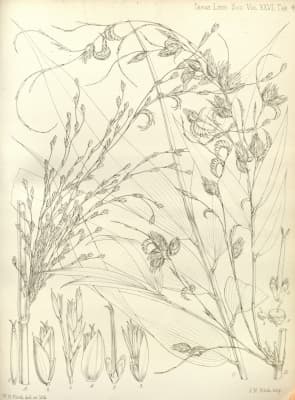
Pseudostachyum polymorphum
Pseudostachyum polymorphum
Safety & Hazards
None known
Cultivation Details
A plant of subtropical and tropical areas, where it is mainly found at elevations from 300 - 1,200 metres[1]. It grows in areas of high rainfall[1]. Bamboos have an interesting method of growth. Each plant produces a number of new stems annually - these stems grow to their maximum height in their first year of growth, subsequent growth in the stem being limited to the production of new side branches and leaves. In the case of some mature tropical species the new stem could be as much as 30 metres tall, with daily increases in height of 30cm or more during their peak growth time. This makes them some of the fastest-growing species in the world[PFAF]. Bamboos in general are usually monocarpic, living for many years before flowering, then flowering and seeding profusely for a period of 1 - 3 years before usually dying. This species flowers frequently - the flowering resulting in the death of the entire clump[2].
Propagation
Seed - Cite as: Tropical Plants Database, Ken Fern. tropical.theferns.info. 2026-02-20. <tropical.theferns.info/viewtropical.php?id=Pseudostachyum+polymorphum>
Pollinators
Data unavailable
References
- [1]Bamboos of Bhutan — Stapleton. C. · Royal Botanic Gardens, Kew. · 1994 · ISBN 0-947643-67-2 ↩︎Excellent little booklet about the bamboos growing wild and cultivated for food, raw materials etc in Bhutan. Very good guide to identification.
- [2]Bamboos of India: A Compendium — Seethalakshmi K.K., Muktesh Kumar M.S. · Brill. · 2002 · http://www.inbar.int/publication/txt/tr17/default.htm · ISBN 8186247254 ↩︎A very good book giving botanical descriptions of the plants with brief notes on subjects such as uses, habitat and range. It is also available to view on the Internet.
- [3]The Commercial Products of India. — Watts. Sir George. · John Murray, London. · 1908 ↩︎A classic, with a comprehensive (as then known) listing of useful plants that were traded commercially at that time. It can be downloaded from various sites on the Internet.
- [4]Mansfeld's Database of Agricultural and Horticultural Plants — http://mansfeld.ipk-gatersleben.de/pls/htmldb_pgrc/f?p=185:3:4292127278597336 ↩︎Terse details of a huge range of useful plants.
- [PFAF]Plants for a Future — pfaf.org ↩︎