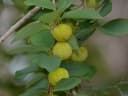
Pseudolachnostylis maprouneifolia
Pseudolachnostylis maprouneifolia
Safety & Hazards
None known
Cultivation Details
Grows best on soils of light texture[1]. A fairly slow-growing tree[2]. Mature trees are moderately resistant to fires[3]. Plants can be pruned back severely and respond well to coppicing[3]. A dioecious species, both male and female forms need to be grown if fruit and seed are required[3].
Propagation
Seed - sow in a nursery seedbed. The seed naturally passes through the gut of a creature before germinating and does not germinate so well if it has not had this treatment. An alternative way of improving the germination rate is by pouring a small amount of nearly boiling water on the seeds (being careful not to cook them!) and then soaking them for 12 - 24 hours in warm water before sowing them[2, 3, PFAF]. Seeds can be stored for later use. Cite as: Tropical Plants Database, Ken Fern. tropical.theferns.info. 2026-02-20. <tropical.theferns.info/viewtropical.php?id=Pseudolachnostylis+maprouneifolia>
Pollinators
Bees, Wasps
References
- [1]Useful Plants of Nyasaland — Williamson J. · The Government Printer, Zomba, Nyasaland. · 1955 · http://www.biodiversitylibrary.org ↩︎Brief details of the uses of almost 500 species of plants.
- [2]PlantZAfrica.com — http://www.plantzafrica.com ↩︎An excellent site giving detailed descriptions and uses of many S. African plants.
- [3]Protabase - Plant Resources of Tropical Africa. — http://www.prota.org ↩︎An excellent on-line database with detailed information on over 3,200 species of useful plants of Africa.
- [4]Flora Zambesiaca — http://apps.kew.org/efloras/fz/intro.html ↩︎An excellent online flora of plants from the Zambezi River basin. It lists a number of the plant uses as well as the habitats and botanical descriptions of the plants.
- [5]African Flowering Plants Database — Conservatoire et Jardin Botaniques. · http://www.ville-ge.ch/musinfo/bd/cjb/africa/recherche.php ↩︎Contains information on over 150,000 plant names (including synonyms) giving a description and habitat, plus a distribution map.
- [PFAF]Plants for a Future — pfaf.org ↩︎