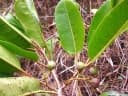
Prunus africana
Prunus africana
Safety & Hazards
The bark, bruised leaves and fruits smell strongly of bitter almonds, suggesting the presence of hydrogen cyanide. They are reputed to be poisonous and are used in witchcraft[1]. The plant (especially the seed and young shoots) contains cyanogenic glycosides, especially amygdalin and prunasin. When injested, these compounds break down in the digestive tract to release cyanide. Used in small quantities in both traditional and conventional medicine, this exceedingly poisonous compound has been shown to stimulate respiration, improve digestion, and promote a sense of well-being[2]. It is also claimed by some to be of benefit in the treatment of cancer - though this claim has been largely refuted. In larger concentrations, however, cyanide can cause gasping, weakness, excitement, pupil dilation, spasms, convulsions, coma and respiratory failure leading to death[3]. The fruits and flowers of most members of this genus generally have low or very low concentrations of this toxin, though the seeds and young shoots can contain much higher levels. The levels of toxin can be detected by the level of bitterness:- for example sweet tasting almond seeds are a major food crop and are often eaten in quantity, whilst bitter tasting almond seeds are used as a flavouring (in marzipan for example) but are not usually eaten on their own. In general, it can be considered safe to eat any fruit or seed from species in this genus that either have a sweet flavour or are slightly bitter. Great caution should be taken, however, if the flavour is moderately to very bitter[PFAF].
Cultivation Details
A tree of higher elevations in the humid and semi-humid tropics, also of middle elevations in the humid tropics, it is found at elevations from 900 - 3,400 metres[1]. It grows best in areas where the mean annual temperature is within the range 14 - 18°c, but can tolerate 12 - 26°c[1]. It prefers a climate with a distinct dry season and a mean annual rainfall in the range 900 - 1,400mm, but can tolerate 700 - 2,000mm[1]. Requires a sunny position[1]. Prefers medium to light soils[1]. Prefers a pH in the range 5.5 - 6.5, but tolerates 5 - 7[1]. The tree is able to withstand severe bark removal so long as the cambium layer is not damaged, but poor harvesting of the bark may lead to tree death[4]. The bark is only collected from two quarters of the circumference of the tree, each quarter on opposite sides of the tree. It is harvested from about 35cm above the ground level to the height of the first branch[4]. In this way, it is thought that the bark can be harvested sustainably every 4 - 5 years, harvesting from alternate pairs of quarters each time[4]. Mean bark yield per tree is 55 kg, ranging from a low of 34 kg up to 74 kg[4]. Bark removal induces early flowering[4].
Propagation
Seed - does not require pre-treatment[4]. It has a fairly short period of viability and is best sown as soon as it is ripe. Under ideal conditions, germination takes place within 35 - 50 days; expected germination rate of a mature, healthy seed lot is 60 - 80%[4]. Cite as: Tropical Plants Database, Ken Fern. tropical.theferns.info. 2026-02-20. <tropical.theferns.info/viewtropical.php?id=Prunus+africana>
Pollinators
Bees
References
- [1]Ecocrop — http://ecocrop.fao.org/ecocrop/srv/en/home ↩︎Basic information on a wide range of useful plants, plus details of environmental needs where available.
- [2]Encyclopaedia of Herbs and their Uses. — Bown. D. · Dorling Kindersley, London. · 1995 · ISBN 0-7513-020-31 ↩︎A very well presented and informative book on herbs from around the globe. Plenty in it for both the casual reader and the serious student. Just one main quibble is the silly way of having two separate entries for each plant.
- [3]Poisonous Plants of North Carolina — http://www.ces.ncsu.edu/depts/hort/consumer/poison/poison.htm ↩︎An excellent concise but comprehensive guide to toxic plants that grow in N. Carolina. It lists even those plants that are of very low toxicity, including several well-known food plants such as carrots and potatoes.
- [4]World Agroforesty Centre — http://www.worldagroforestry.org/ ↩︎An excellent online database of a huge range of trees giving very good information on each plant - its uses, ecology, identity, propagation, pests etc.
- [5]The Useful Plants of West Tropical Africa. — Burkil. H. M. · Royal Botanic Gardens; Kew. · 1985 - 2004 ↩︎Brief descriptions and details of the uses of over 4,000 plants. A superb, if terse, resource, it is also available electronically on the Web - see http://www.aluka.org/
- [6]African Flowering Plants Database — Conservatoire et Jardin Botaniques. · http://www.ville-ge.ch/musinfo/bd/cjb/africa/recherche.php ↩︎Contains information on over 150,000 plant names (including synonyms) giving a description and habitat, plus a distribution map.
- [7]IUCN Red List of Threatened Species — http://www.iucnredlist.org/ ↩︎A list of plants under threat and facing possible extinction, usually with brief details of the threats and information on habitat.
- [8]Contribution to an evaluation of tree species using the new CITES Listing Criteria — UNEP-WCMC; Cambridge. · 1999 · http://sea.unep-wcmc.org/species/tree_study/ ↩︎A document produced by UNEP World Conservation Monitoring Centre in 1999. It contains fact sheets on more than 200 tree species from around the globe.
- [9]Pharmaceutical monographs for 60 South African plant species — Scott, G. and Springfield, E.P. · 2004 · http://www.plantzafrica.com/medmonographs ↩︎A series of 60 monographs of S. African medicinal plants. Well written, with information on traditional uses and modern research into the plants.
- [10]Tropical Timbers of the World. Ag. Handbook No. 607. — Chudnoff. Martin. · USDA Forest Service. Wisconsin. · 1984 ↩︎Terse details on the properties of the wood of almost 400 species of trees from the Tropics.
- [11]Useful Plants of Nyasaland — Williamson J. · The Government Printer, Zomba, Nyasaland. · 1955 · http://www.biodiversitylibrary.org ↩︎Brief details of the uses of almost 500 species of plants.
- [PFAF]Plants for a Future — pfaf.org ↩︎