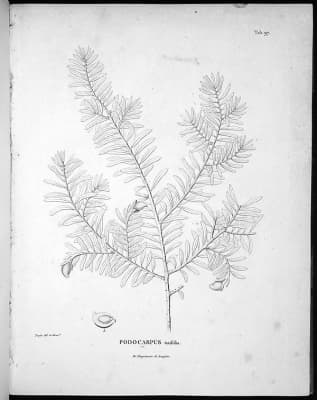
Prumnopitys montana
Prumnopitys montana
Safety & Hazards
None known
Cultivation Details
A plant of moderate to high regions in the tropics, where it is found at elevations from 1,900 - 3,000 metres[1]. It grows best in areas with an average annual temperature of 8 - 16°c and an annual precipitation of 600 - 3,000 mm[1]. It can tolerate short frosts with occasional temperatures falling to between -1°c and +4.4°c[2, 1]. The tree adapts to poor soils with good drainage, acid pH, and loose clayey texture[1].
Propagation
Seed - germination takes place in about 3 months with 45 - 60% germinating[1]. Because the seeds are relatively large, they can be planted in bags. The planting hole should be 2 cm deep and separated from other holes by 20 cm. The seeds are covered with fine, well packed soil, watered abundantly, and shaded during the first 6 months[1]. The cones are collected from the tree or the ground. Old cones or seeds are not collected because the seeds are frequently attacked by a borer on the ground. Seeds are stored at 3 - 4°c[1]. Cite as: Tropical Plants Database, Ken Fern. tropical.theferns.info. 2026-02-20. <tropical.theferns.info/viewtropical.php?id=Prumnopitys+montana>
Pollinators
Wind
References
- [1]Tropical Tree Seed Manual — Vosso. J. Editor. · USDA Forest Service. · 2002 · http://www.rngr.net/Publications/ttsm ↩︎An extremely good guide, it can also be downloaded in its entirety from the address shown above.
- [2]The Gymnosperm Database — http://www.conifers.org/index.htm ↩︎A vast amount of information on conifers and families of gymnosperms.
- [3]IUCN Red List of Threatened Species — http://www.iucnredlist.org/ ↩︎A list of plants under threat and facing possible extinction, usually with brief details of the threats and information on habitat.
- [4]Dictionary of Economic Plants. — Uphof. J. C. Th. · Weinheim · 1959 · ISBN - ↩︎An excellent and very comprehensive guide but it only gives very short descriptions of the uses without any details of how to utilize the plants. Not for the casual reader.