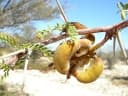
Prosopis tamarugo
Prosopis tamarugo
Safety & Hazards
None known
Cultivation Details
The plant occurs naturally in arid areas of the tropics, within the latitudinal range 18 - 21°S, at elevations from 1,000 - 2,500 metres[1]. It grows best in areas where annual daytime temperatures are within the range 18 - 32°c, but can tolerate 8 - 36°c[1]. Dormant plants can be killed by temperatures of -12°c or lower, though fresh young growth can be killed at -1°c[1]. It prefers a mean annual rainfall in the range 150 - 250mm, but tolerates 100 - 300mm[1]. It is often found in areas where there is no rain for years at a time; however, at night there is a high relative humidity and the trees absorb moisture through the leaves[1]. Requires a sunny position. Succeeds on salty, salty-sandy or clay-loam soils, sometimes with a 40cm salt encrustation at the surface[2]. Prefers a pH in the range 7 - 8, tolerating 6.5 - 8.5[1]. Established plants are very drought resistant, able to go for 12 months or more without rain[1]. Under less harsh conditions that the plant experiences in its native environment, the plant might spread uncontrollably and become a serious weed[1]. Trees can reach 10 metres in height within 15 years, even under harsh conditions[1]. The tree coppices well, regenerating rapidly when cut back[2, 1]. Annual wood production potential is 2 - 4 cubic metres per hectare[1]. This species has a symbiotic relationship with certain soil bacteria, these bacteria form nodules on the roots and fix atmospheric nitrogen. Some of this nitrogen is utilized by the growing plant but some can also be used by other plants growing nearby[3].
Propagation
Like many species within the family Fabaceae, once they have ripened and dried the seeds of this species may benefit from scarification before sowing in order to speed up and improve germination. This can usually be done by pouring a small amount of nearly boiling water on the seeds (being careful not to cook them!) and then soaking them for 12 - 24 hours in warm water. By this time they should have imbibed moisture and swollen - if they have not, then carefully make a nick in the seedcoat (being careful not to damage the embryo) and soak for a further 12 hours before sowing[PFAF]. Cite as: Tropical Plants Database, Ken Fern. tropical.theferns.info. 2026-02-20. <tropical.theferns.info/viewtropical.php?id=Prosopis+tamarugo>
Pollinators
Bees
References
- [1]Ecocrop — http://ecocrop.fao.org/ecocrop/srv/en/home ↩︎Basic information on a wide range of useful plants, plus details of environmental needs where available.
- [2]World Agroforesty Centre — http://www.worldagroforestry.org/ ↩︎An excellent online database of a huge range of trees giving very good information on each plant - its uses, ecology, identity, propagation, pests etc.
- [3]Nodulation Plants in GRIN Taxonomy — United States Department of Agriculture · http://www.ars-grin.gov/~sbmljw/cgi-bin/taxnodul.pl?language=en ↩︎An online database listing plants that have either positive or negative reports on root and stem nodulation with nitrogen-fixing bacteria.
- [4]Journal of the Arnold Arboretum Vol. 57 — Harvard University · 1976 · http://www.biodiversitylibrary.org ↩︎A botanical magazine, this issue has a comprehensive treatment of the genus Prosopis as well as several other articles. It can be downloaded from the Internet.
- [5]IUCN Red List of Threatened Species — http://www.iucnredlist.org/ ↩︎A list of plants under threat and facing possible extinction, usually with brief details of the threats and information on habitat.
- [PFAF]Plants for a Future — pfaf.org ↩︎