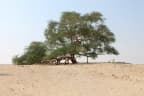
Prosopis cineraria
Prosopis cineraria
Safety & Hazards
None known
Cultivation Details
Prosopis cineraria is a plant of arid and semi arid, lowland tropical and subtropical areas, where it is found at elevations from sea level to 600 metres[1, 2, 3]. It is found in areas where the mean annual rainfall is in the range 200 - 800 mm[1]. One estimation has said that the plant can tolerate up to 2,000mm of rain[4]. In some areas of its natural distribution, the climate is characterised by extremes of temperature. The summers are very hot and winters can be severe with frost[1]. The maximum shade temperature varies from about 40 - 46°c, the absolute minimum temperature from 9 - 16°c[1]. Although young plants, and young growth on older plants, are sensitive to frost[4], Mature plants can tolerate occasional, short-lived frosts down to -6°c[2]. In its natural range, the plant grows on coarse sandy soils[1]. It can however grow on a variety of soils. Good growth is obtained on deep sandy loam soil with adequate availability of moisture in lower layers. Shallow dry soils with hard layer beneath, which restricts root penetration, results in poor growth. In arid areas, the growth is better in dune lows than in sandy plains, which in turn offer better site than the dune tops. Good drainage is very essential and poorly drained soils are not suitable[1]. It does not survive long on pure sandy soils. On saline soils also it quickly dies out, but it can grow on slightly alkaline soils[1]. Prefers a pH in the range 6.5 - 8.5, tolerating 5.5 - 9.8[4, 3]. Established plants are very drought tolerant[3]. Tolerant of hot, dry winds[3]. The trees start flowering and fruiting at an early age[1]. This species has a life expectancy of 200 years or more[5]. Trees can be coppiced[1]. The plant produces a taproot that is more than 3 metres long[1]. This species has a symbiotic relationship with certain soil bacteria, these bacteria form nodules on the roots and fix atmospheric nitrogen. Some of this nitrogen is utilized by the growing plant but some can also be used by other plants growing nearby[6].
Propagation
Seed - germinates best if the hard seed coat is softened first to allow the ingress of water. This can be done by adding a small amount of almost boiling water to the seed (which should cool down quickly enough so that it does not cook the seed!). Then soak the seed for 12 - 24 hours prior to sowing. Alternatively, carefully abrade an area of the seed coat, being careful not to damage the embryo. The seeds retain their viability for at least one year[1]. The seed retains its viability for decades[4]. The tree reproduces freely by root suckers[1]. Cite as: Tropical Plants Database, Ken Fern. tropical.theferns.info. 2026-02-20. <tropical.theferns.info/viewtropical.php?id=Prosopis+cineraria>
Pollinators
Insects
References
- [1]World Agroforesty Centre — http://www.worldagroforestry.org/ ↩︎An excellent online database of a huge range of trees giving very good information on each plant - its uses, ecology, identity, propagation, pests etc.
- [2]Plant Resources of Southeast Asia — http://proseanet.org/ ↩︎Lots of information on the uses of the plants of SE Asia.
- [3]Ecocrop — http://ecocrop.fao.org/ecocrop/srv/en/home ↩︎Basic information on a wide range of useful plants, plus details of environmental needs where available.
- [4]Handbook of Energy Crops — Duke. J. · - · 1983 · https://hort.purdue.edu/newcrop/duke_energy/dukeindex.html · ISBN - ↩︎Published only on the Internet, excellent information on a wide range of both temperate and tropical plants.
- [5]Grassland Species - Profiles — http://www.fao.org/ag/AGP/AGPC/doc/Gbase/Default.htm ↩︎Terse information on over 650 species of plants that grow in grassland, including trees, shrubs and perennial plants as well as grasses. Gives a brief description of the plant, its range and habitat and some of its uses.
- [6]Nodulation Plants in GRIN Taxonomy — United States Department of Agriculture · http://www.ars-grin.gov/~sbmljw/cgi-bin/taxnodul.pl?language=en ↩︎An online database listing plants that have either positive or negative reports on root and stem nodulation with nitrogen-fixing bacteria.
- [7]Forest, Farm, and Community Tree Network — http://www.winrock.org/fnrm/factnet/factnet.htm ↩︎A series of in-depth factsheets on a wide range of plants, especially leguminous trees.
- [8]Journal of the Arnold Arboretum Vol. 57 — Harvard University · 1976 · http://www.biodiversitylibrary.org ↩︎A botanical magazine, this issue has a comprehensive treatment of the genus Prosopis as well as several other articles. It can be downloaded from the Internet.
- [9]Mansfeld's Database of Agricultural and Horticultural Plants — http://mansfeld.ipk-gatersleben.de/pls/htmldb_pgrc/f?p=185:3:4292127278597336 ↩︎Terse details of a huge range of useful plants.
- [10]Flora of Pakistan — http://www.efloras.org ↩︎As of 2006, there is not much information on habitats available, but it is being developed and promises to be an excellent resource.
- [11]Glossary of Indian Medicinal Plants (Including the Supplement). — Chopra. R. N., Nayar. S. L. and Chopra. I. C. · Council of Scientific and Industrial Research, New Delhi. · 1986 · ISBN - ↩︎Very terse details of medicinal uses of plants with a wide range of references and details of research into the plants chemistry. Not for the casual reader.