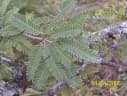
Prosopis affinis
Prosopis affinis
Safety & Hazards
None known
Cultivation Details
Prosopis affinis is a plant of low elevations in the tropics and subtropics, being found as far south as about 30°s in northeastern Argentina, where it can experience occasional light frost. It grows better where the mean annual rainfall is in the range 600 - 1,200mm[1]. Prefers a sunny position[1]. Established trees are drought tolerant[1]. The growth rate of this species is not as slow as many people believe where the species is cultivated from Chaco seed[2]. Specimens were full-grown and produced mature fruits for the first time at the age of 7½ years when they were 3.5 metres tall with a trunk 75mm in diameter[2]. The flowers are a valuable bee fodder[2]. There are conflicting reports on whether or not this tree has a symbiotic relationship with certain soil bacteria, so it is unclear as to whether this tree fixes atmospheric nitrogen[3].
Propagation
Like many species within the family Fabaceae, once they have ripened and dried the seeds of this species may benefit from scarification before sowing in order to speed up and improve germination. This can usually be done by pouring a small amount of nearly boiling water on the seeds (being careful not to cook them!) and then soaking them for 12 - 24 hours in warm water. By this time they should have imbibed moisture and swollen - if they have not, then carefully make a nick in the seedcoat (being careful not to damage the embryo) and soak for a further 12 hours before sowing[PFAF]. Cite as: Temperate Plants Database, Ken Fern. temperate.theferns.info. 2026-02-21. <temperate.theferns.info/plant/Prosopis+affinis>
Pollinators
Bees, Insects
References
- [1]Grassland Species - Profiles — http://www.fao.org/ag/AGP/AGPC/doc/Gbase/Default.htm ↩︎Terse information on over 650 species of plants that grow in grassland, including trees, shrubs and perennial plants as well as grasses. Gives a brief description of the plant, its range and habitat and some of its uses.
- [2]Journal of the Arnold Arboretum Vol. 57 — Harvard University · 1976 · http://www.biodiversitylibrary.org ↩︎A botanical magazine, this issue has a comprehensive treatment of the genus Prosopis as well as several other articles. It can be downloaded from the Internet.
- [3]Nodulation Plants in GRIN Taxonomy — United States Department of Agriculture · http://www.ars-grin.gov/~sbmljw/cgi-bin/taxnodul.pl?language=en ↩︎An online database listing plants that have either positive or negative reports on root and stem nodulation with nitrogen-fixing bacteria.
- [4]Mansfeld's Database of Agricultural and Horticultural Plants — http://mansfeld.ipk-gatersleben.de/pls/htmldb_pgrc/f?p=185:3:4292127278597336 ↩︎Terse details of a huge range of useful plants.
- [5]IUCN Red List of Threatened Species — http://www.iucnredlist.org/ ↩︎A list of plants under threat and facing possible extinction, usually with brief details of the threats and information on habitat.
- [6]Dictionary of Economic Plants. — Uphof. J. C. Th. · Weinheim · 1959 · ISBN - ↩︎An excellent and very comprehensive guide but it only gives very short descriptions of the uses without any details of how to utilize the plants. Not for the casual reader.
- [7]Flore Forestiere Du Globe — Chnacerel L. · Gauthier-Villars et Co.; Paris. · 1920 · http://www.biodiversitylibrary.org ↩︎Written in French, a very detailed work on the timbers of the world. It can be downloaded from the Internet.
- [8]Plantae Diaphoricae Florae Argentinae ó Revista Sistematica de las Plantas medicinales, alimenticias ó de alguna otr — Hieronymus J. · Guillermo Kraft; Buenos Aires · 1882 ↩︎A very old work, but lots of information on the uses of Argentinian plants. It can be downloaded from the internet.
- [PFAF]Plants for a Future — pfaf.org ↩︎