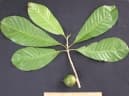
Pouteria multiflora
Pouteria multiflora
Safety & Hazards
None known
Cultivation Details
A plant of the moist to wet tropical lowlands and lower montane regions. It is mostly confined to areas where the mean annual rainfall is within the range 1,400 - 3,000mm, either with no dry season or a dry season of up to 4 months[1]. The mean temperature of the coolest month is around 22°c and the hottest month 27°c, with a complete absence of frosts[1]. Succeeds in full sun, but also thrives in the shade of other trees. Most commonly found on clay soils derived from limestone and igneous rocks, also succeeding in sandy loamd[1]. Growth is best in a moist but well-drained soil[1]. Prefers a pH in the range 4.5 - 7[1]. Seedlings sometimes are numerous in the shade of a parent tree[2]. They can survive 10 - 20 years in the understorey, growing larger if a gap in the canopy opens up[1]. Seedlings quickly produce strong taproots with numerous laterals. In older trees the roots are deep and extensive, often protruding above ground level in clay soils. The plant thus becomes very resistant to windthrow in strong winds and, whilst it can often lose its upper branches, it will generally recover quickly[1]. On favourable sites with sufficient light, 5 year old trees can be 3 - 6 metres tall with boles 25 - 50mm in diameter[1]. Trees commence flowering at around the age of 20 - 30 years, once the crown is well-developed[1]. Flowering and fruiting takes place for about half the year, but in moister climates the fruit ripens nearly throughout the year[2]. A large tree will bear from 200 to 300 fruits a year[1]. Trees respond well to coppicing[1].
Propagation
Seed - it cannot tolerate being dried and so is best sown as soon as it is ripe. Sow the large seed in situ or in individual containers, either in light shade or in full sun. The seed can sprout within 20 - 70 days with a 50 - 100% germination rate[1]. Approximately 20% of seedlings produce multiple leaders[1]. Seedlings are ready to plant out when 40cm tall, at about the age of 5 months[1]. Cite as: Tropical Plants Database, Ken Fern. tropical.theferns.info. 2026-02-20. <tropical.theferns.info/viewtropical.php?id=Pouteria+multiflora>
Pollinators
Insects
References
- [1]Pouteria multiflora (A.DC.) Eyma. Jacana, Bully-tree. Sapotaceae. Sapodilla family. — Parrotta J.A. and Francis J.K. · USDA Forest Service · 1993 · http://www.treesearch.fs.fed.us/pubs/30354 ↩︎A very detailed article on Pouteria multiflora. It can be downloaded from the internet.
- [2]Common Trees of Puerto Rico and the Virgin Islands — Little E.L.; Wadsworth F.H. · USDA, Forest Service; Washington. · 1964 ↩︎Contains detailed information, and usually an illustration, on 250 tree species, including both native and exotic species.
- [3]Trade Winds Fruit — http://www.tradewindsfruit.com/index.htm ↩︎The on-line catalogue of a company selling seeds. Gives descriptions, photos and uses of a very wide range of fruit and other food-producing plants plus ornamentals.
- [4]Flora of Dominica, Part 2: Dicotyledoneae — Nicolson D.H.; et al · Smithsonian Institute Press; Washington · 1991 · http://www.sil.si.edu/smithsoniancontributions/Botany/ · ISBN 90-10415 ↩︎A terse but very useful flora with a somewhat limited botanical description plus range, habitat and some uses. It can be downloaded from the Internet.