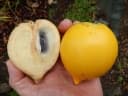
Pouteria caimito
Pouteria caimito
Safety & Hazards
None known
Cultivation Details
A tree of the hot, wet, tropical lowlands, it requires a year-round moist and warm climate[1, 2]. Plants are intolerant of frost[1]. Succeeds in full sun and in dappled shade[3]. Grows well in wet soils[2]. Prefers an acid soil[1]. Seedling trees take up to 8 years before they start to fruit, and some are very shy fruiters[4]. It is therefore best to propagate vegetatively from good fruiting forms[4]. Grafted plants can fruit in 3 - 4 years[1]. Good forms can fruit twice a year[4]. Mature trees may produce anywhere from 100 - 1,000 fruits a year[2]. A large tree, it is best kept pruned to about 4 metres tall in order to make fruit harvest easier[4]. There are some named varieties[5]. The quality of the fruits is much higher in recent selected strains[6]. Some forms are self-fertile, though others need cross-pollination[1].
Propagation
Seed - remove it from its husk before sowing[7]. Best sown as soon as it is ripe[3]. Sow in a nursery seedbed in semi-shade. When sown fresh, the seed usually germinates in 4 - 6 weeks, with a reasonable percentage germinating[2, 3]. Side-grafting. Air-layering may be possible[7]. Cite as: Tropical Plants Database, Ken Fern. tropical.theferns.info. 2026-02-20. <tropical.theferns.info/viewtropical.php?id=Pouteria+caimito>
Pollinators
Data unavailable
References
- [1]Perennial Edible Fruits of the Tropics : an Inventory — Martin, F. W.; Campbell, C. W.; Rubertbe, R. M. · U.S. Dept. of Agriculture, Agricultural Research Service · 1987 ↩︎A booklet giving terse details of almost 300 species of edible fruits, plus regional lists of Botanical and Common names for over 2,500 less well-known edible fruits of the tropics.
- [2]Trade Winds Fruit — http://www.tradewindsfruit.com/index.htm ↩︎The on-line catalogue of a company selling seeds. Gives descriptions, photos and uses of a very wide range of fruit and other food-producing plants plus ornamentals.
- [3]Brazilian Trees. Volume 2. 4th Edition. — Lorenzi. H. · Instituto Plantarum De Estudos Da Flora; Brazil. · 2002 · ISBN 85-86714-15-1 ↩︎Information on 350 species of Brazilian trees. Stunning photographs of each species, brief details on the plant, its uses and how to grow it from seed. A superb work, with the minor irritation that the translation from Portuguese is not of the best.
- [4]Tropical Food Gardens — Norrington. L. · Bloomings Books (Melbourne) · 2001 · ISBN 1-876473-41-x ↩︎Excellent little book giving some basic information on a range of plants.
- [5]Cornucopia II — Facciola. S. · Kampong Publications, California. · 1998 · ISBN 0-9628087-2-5 ↩︎The second edition of an excellent guide to the edible uses of plants, though it does not give any details of cultivation etc.
- [6]Mansfeld's Database of Agricultural and Horticultural Plants — http://mansfeld.ipk-gatersleben.de/pls/htmldb_pgrc/f?p=185:3:4292127278597336 ↩︎Terse details of a huge range of useful plants.
- [7]The New RHS Dictionary of Gardening. 1992. — Huxley. A. · MacMillan Press · 1992 · ISBN 0-333-47494-5 ↩︎Excellent and very comprehensive, though it contains a number of silly mistakes. Readable yet also very detailed.
- [8]Brazilian Fruits and Cultivated Exotics — Lorenzi. H.; Bacher. L.; Lacerda. M.; Sartori. S. · Instituto Plantarum De Estudos Da Flora LTDA; Brazil. · 2000 · ISBN 85-867174-24-0 ↩︎A superb book, giving information on several hundred fruit species. Each entry has a brief description of the plant and its uses, accompanied by one to many excellent quality photographs of the fruits.