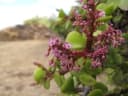
Portulacaria afra
Portulacaria afra
Safety & Hazards
None known
Cultivation Details
A plant of drier areas in the subtropics and tropics. It can tolerate a moderate degree of frost, down to at least -1°c[1, 2]. Succeeds in full sun or semi-shade[1]. Established plants are very drought resistant[2]. An interesting ecology has been observed with this plant in the Eastern Cape where it forms part of the diet of the Addo elephants in the Addo National Park. Elephants eat the plant from the top downwards allowing the plant to spread itself vegetatively by spreading horizontal branches at ground level. Outside the park the same plants are eaten by goats who eat the plant from ground level upwards preventing the plant from spreading vegetatively. Consequently these latter plants must rely solely on seed to proliferate the species, which often proves difficult in such a dry climate. As a result is was observed that inside the park where the plant is subjected to browsing by elephants, Portulacaria afra survives and spreads successfully, whereas outside the park the plant is becoming sparse as a result of overgrazing and poor regeneration[1].
Propagation
Seed - Cuttings, even when quite large, root easily. They can be planted directly into the ground where they are to be grown[1]. Alternatively, the cuttings can be taken in the normal fashion and allowed to dry out for a day or two in a cool dry place and then planted in washed river sand and kept in a shady position until they are rooted and ready to be planted out. They root quickly and can usually be planted out after four to six weeks[1]. Cite as: Tropical Plants Database, Ken Fern. tropical.theferns.info. 2026-02-20. <tropical.theferns.info/viewtropical.php?id=Portulacaria+afra>
Pollinators
Insects
References
- [1]PlantZAfrica.com — http://www.plantzafrica.com ↩︎An excellent site giving detailed descriptions and uses of many S. African plants.
- [2]Desert Tropicals — http://www.desert-tropicals.com/ ↩︎The main focus of the site is succulent plants, but it also contains information on a wide range of other species. Usually at least one good photograph, plus basic information about the plant and its cultivation.
- [3]Cornucopia II — Facciola. S. · Kampong Publications, California. · 1998 · ISBN 0-9628087-2-5 ↩︎The second edition of an excellent guide to the edible uses of plants, though it does not give any details of cultivation etc.