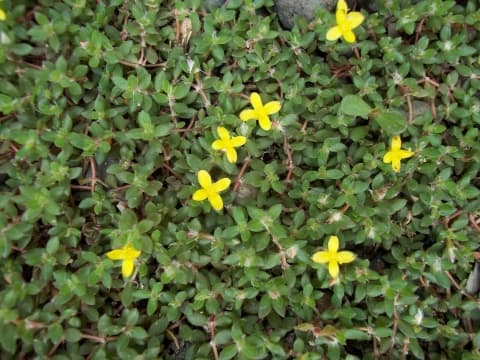
Portulaca quadrifida
Portulaca quadrifida
Cultivation Details
The plant is widespread in the tropics. It grows best in areas where annual daytime temperatures are within the range 22 - 32°c, but can tolerate 16 - 36°c[2]. It prefers a mean annual rainfall in the range 1,500 - 2,000mm, but tolerates 1,000 - 2,500mm[2]. Requires a sunny position in a well-drained soil. Tolerant of a wide range of soils but prefers sand or sandy loams[1]. Plants can succeed in quite poor soils. Prefers a pH in the range 5.5 - 6.5, tolerating 4.5 - 7.5[2]. Plants can become troublesome weeds of cultivation, since they break up easily and even small fragments can grow into new plants[3]. In addition, the seeds are easily spread by wind, water, with crop seeds or through bird droppings[1]. The plants take about six to eight weeks to produce a crop from seed and can then be harvested every two weeks on a cut and come again principle[2]. This species photosynthesizes by a more efficient method than most plants. Called the 'C4 carbon-fixation pathway', this process is particularly efficient at high temperatures, in bright sunlight and under dry conditions[4, 1]. The flowers are said to open promptly at 10am, hence the English name 'ten o'clock plant'[3].
Propagation
Seed - fresh seeds need light for germination, but this requirement disappears in older seeds[1]. Cite as: Tropical Plants Database, Ken Fern. tropical.theferns.info. 2026-02-20. <tropical.theferns.info/viewtropical.php?id=Portulaca+quadrifida>
Pollinators
Data unavailable
References
- [1]Protabase - Plant Resources of Tropical Africa. — http://www.prota.org ↩︎An excellent on-line database with detailed information on over 3,200 species of useful plants of Africa.
- [2]Ecocrop — http://ecocrop.fao.org/ecocrop/srv/en/home ↩︎Basic information on a wide range of useful plants, plus details of environmental needs where available.
- [3]Flora of China — Missouri Botanical Garden Press; St. Louis. · 1994 · http://flora.huh.harvard.edu/china/ ↩︎An excellent, comprehensive resource in 25 volumes. In addition to the botanical information the flora also gives basic information on habitat and some uses. An on-line version is also available.
- [4]Lost Crops of the Incas — Popenoe. H. et al · National Academy Press · 1990 · ISBN 0-309-04264-X ↩︎An excellent book. Very readable, with lots of information and good pictures of some lesser known food plants of S. America.